
Surf Fishing Regulations by State: Licenses, Limits & Rules
Learn surf fishing regulations by state, including licenses, gear rules, seasonal limits, and local restrictions for a legal fishing trip.
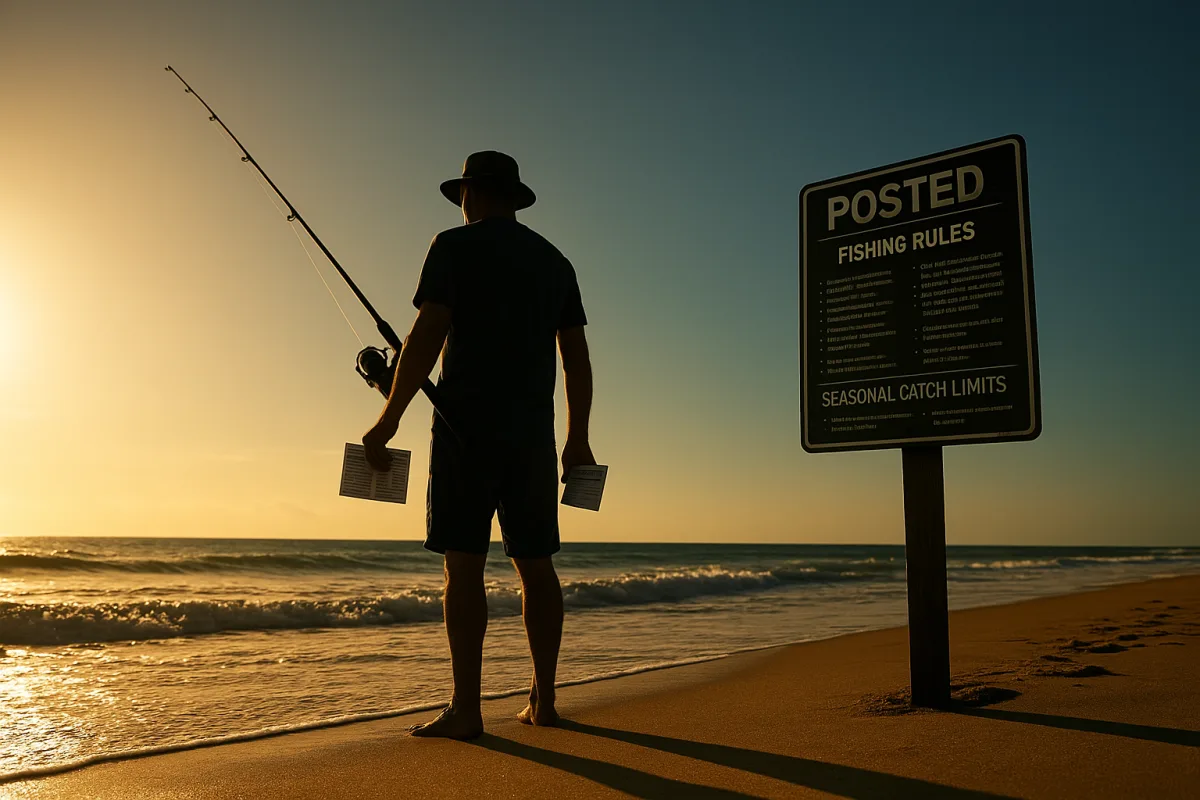
The Regulatory Stack That Controls a Legal Surf-Fishing Trip
Think in layers, not in “state rules”
The useful concept is the regulatory stack. It is the set of overlapping permissions and restrictions that applies to one angler, on one beach, with one method, on one date. Surf anglers get into trouble when they check only the first layer.
Start with the person. All 50 states require a recreational fishing license for anglers age 16 and older, according to the nationwide licensing overview from MyFishingBuds. [15] That does not mean every 16-year-old buys the same document, or that one annual license covers every saltwater situation.
Residency, age, senior status, disability status, and the water being fished can alter the license needed. Nonresident licenses normally cost more than resident licenses. A 2026 fee comparison puts resident annual fees from about $5 in Hawaii to $64.54 in California, although anglers should treat comparison tables as a starting point and confirm current agency pricing. [14]
California shows why “I bought a license” is not a complete answer. The California Department of Fish and Wildlife lists sport-fishing licenses and separate report-card and validation requirements. Its Ocean Enhancement Validation applies to fishing south of Point Arguello, not the entire California coast. [1]
That geographic boundary matters. An angler standing north of Point Arguello is not necessarily under the same validation requirement as one fishing a Southern California beach, even though both hold California licenses. A statewide rule can contain a regional trigger.
Washington is a reminder to verify questionable figures at the original source. A reported resident annual fee of $330.54 is far outside the range cited for other states and may reflect a combined license or a data problem. Check Washington Department of Fish and Wildlife’s current fee page before budgeting or publishing that number. [2]
The beach itself can change the rules
The second layer is the place where your boots are planted. State saltwater regulations may govern the fish, but the beach can be managed by a federal park, national seashore, wildlife refuge, town, tribe, or private landowner. Access law and fishing law are not interchangeable.
Assateague Island National Seashore is a clear example of a separate land-management layer. The National Park Service publishes surf-fishing guidance for the seashore, meaning an angler must account for park-specific conditions in addition to the relevant state fishing rules. [9]
Cape Cod National Seashore likewise maintains its own fishing guidance. That does not erase Massachusetts saltwater regulations, but it means a person planning an outer-Cape surf trip should read both the state rules and the National Park Service material for the particular shoreline. [10]
Cape May National Wildlife Refuge adds another kind of complication. The U.S. Fish and Wildlife Service sets refuge-specific fishing information, and refuges can have access, location, or seasonal conditions that differ from the beach immediately outside their boundary. [11]
The practical implication is simple: pin the intended access point before researching regulations. “New Jersey coast” or “Massachusetts beach” is too broad. Identify the parking area, the beach name, and whether the site is state, federal, municipal, tribal, or private property.
Tribal lands deserve the same caution. The available research does not provide a comprehensive set of tribal surf-fishing rules, so do not assume that a state license automatically answers the question. Confirm requirements directly with the relevant tribal authority before fishing those waters or shorelines.
A license grants access, but harvest rules decide what enters the cooler
The third layer concerns the fish. A legal catch is not simply a fish caught on legal gear by a licensed angler. It must also be in season, within the applicable size rule, below the possession limit, and, in some cases, properly reported.
Slot limits are the most important mechanic for many surf species. A slot says the fish must fall between a minimum and maximum length to be retained. Fish below the slot are protected because they are young. Fish above it may be protected because larger breeders matter disproportionately.
Red drum, often called redfish, shows why crossing a state line with the same cooler plan is risky. North Carolina and Florida use an 18-to-27-inch slot, while Texas uses a 20-to-28-inch slot, according to LegalClarity’s 2026 comparison. [16]
Those two inches matter on a beach where fish may be running close to either edge. A 19-inch red drum can be legal in one state and short in another. A 27½-inch fish can be legal in Texas while exceeding the stated North Carolina and Florida slot.
The right workflow is to identify the target species before tying rigs. Then find the current state rule, determine whether the beach sits in a special management area, and learn the exact size and possession limits. Do not infer a bag limit from a neighboring state.
Seasonal closures are the next part of the harvest layer. They are not merely slow-fishing periods. A closure means the fish may need to remain in the water regardless of how well the tide, bait, and bar are lining up.
North Carolina’s flounder rules make the point sharply. The 2026 reopening described by Axios set a September 1 through September 14 season, while retained flounder also require mandatory reporting under the system introduced in December 2025. [3]
That reporting requirement changes the job after a fish is caught. Measuring and counting are not enough. An angler who keeps a legal flounder must complete the required report. A short season also means that a reliable flounder trough may be irrelevant for retention outside those dates.
California’s 2026 changes include seasonal closures affecting surf-relevant species. The California Fish and Game Commission lists spiny lobster as closed from March 19 through October 2, and white sturgeon as closed from July 1 through September 30. [13]
Those examples illustrate why a tide chart cannot answer a legal question. An incoming evening tide may be ideal for the species’ feeding behavior, but if the season is closed, the only sensible plan is to target another legal fish or leave the gear home.
New Jersey’s 2026 bluefish regulation update is another reason to use the current notice rather than memory. The New Jersey Department of Environmental Protection announced increased bluefish possession limits for 2026. [12] A saved limit from a prior year can be wrong in either direction.
Gear rules control the rig before the cast
The fourth layer is method. Surf anglers tend to focus on rod rating, sinker grip, hook pattern, and bait presentation. Regulations can dictate those choices just as directly as wind, current, or a steep beach break.
Massachusetts has unusually specific restrictions on hook-and-line gear. State regulations prohibit using natural bait with a weight embedded in it, except when that weighted bait is at the end of the line. [6] That is a rig-design rule, not a vague recommendation.
In practice, do not assume a weighted bait presentation that is legal elsewhere will pass in Massachusetts. If the bait is carrying weight somewhere other than the terminal end of the line, the construction itself may be the problem. Read the current wording before adapting specialty bait rigs.
Massachusetts also prohibits mechanized deployment of baited hooks from shore under its saltwater fishing regulations. [4] That matters to anglers accustomed to devices or powered systems that carry baited lines beyond casting range. The beach does not make every long-range delivery method legal.
Texas separates legal methods by the kind of fish being pursued. Texas Parks and Wildlife says its device and method rules limit hooks and cast nets in ways that distinguish game fish from nongame fish. [7] A cast net is not a general-purpose way to acquire any desired surf bait or fish.
Hawaii similarly publishes gear restrictions through its Division of Aquatic Resources. [8] The important planning habit is not memorizing one state’s list, but treating netting, hook arrangements, bait deployment, and capture methods as separate questions whenever fishing unfamiliar water.
California also regulates sport-fishing methods and validations through its official licensing and regulations system. [1][13] The sensible sequence is to choose a legal category of rig first, then refine it for conditions, such as using enough sinker weight to hold bottom without violating local method restrictions.
Build the legal plan around the forecast
A forecast-first surf angler already works from constraints. Wind direction determines whether casting is practical. Tide stage determines whether a trough is fishable. Swell determines whether a bar, cut, or point is holding water safely enough to reach. Regulations belong in that same first pass.
The night before, check four items in order: the agency’s current license and validation page, the current species rules, the specific beach manager’s access rules, and any emergency or seasonal notices. California’s new regulations became effective across February through May 2026, which is exactly why old PDFs and social posts age badly. [13]
Then match the trip to what is actually open. If red drum are legal but outside the slot, plan to release every fish carefully. If flounder season is closed, do not carry a retention plan based on last autumn. If a refuge restricts access, choose another beach.
That approach is unsentimental, but it saves wasted drives. The best-looking outgoing tide over a bait-filled hole produces nothing useful if the species is closed, the access point is unavailable, or the rig is prohibited. Legal opportunity comes before fishing opportunity.
Frequently Asked Questions
What are the surf fishing regulations in my state?
Surf fishing regulations vary widely by state and even by specific locations within a state. You must consider multiple layers of rules including state fishing regulations, local access restrictions, and any federal or tribal land rules that apply to the exact beach where you fish. Always check the precise beach and date for current regulations rather than relying on broad state summaries.
Do I need a special license for surf fishing in different states?
All 50 states require a recreational fishing license for anglers age 16 and older, but the type of license and additional validations or permits can differ. For example, California requires an Ocean Enhancement Validation south of Point Arguello, while New Jersey requires surf fishing permits only at Island Beach State Park. Residency, age, and the specific waters you fish influence what license or permits you need.
How do surf fishing rules vary between states?
Rules vary in terms of license fees, species size and bag limits, seasonal closures, gear restrictions, and reporting requirements. For instance, red drum slot limits differ: North Carolina and Florida use an 18–27 inch slot, while Texas uses 20–28 inches. Seasonal closures and reporting rules also differ, such as North Carolina’s flounder season reopening with mandatory catch reporting starting in 2026.
What gear is legal for surf fishing in each state?
Legal gear varies significantly by state and location. Massachusetts prohibits mechanized deployment of baited hooks from shore and restricts natural bait with embedded weights, while California limits hook types and prohibits cast nets except in specific cases. Texas restricts hooks and cast nets to nongame fish only. Check local rules before assembling your surf fishing rig.
Are there seasonal closures for surf fishing by state?
Yes, many states have seasonal closures for certain species. Examples include North Carolina’s flounder season from September 1 to 14, California’s spiny lobster closure from March 19 to October 2, and white sturgeon closure from July 1 to September 30. Seasonal closures may also be imposed by federal lands or wildlife refuges, so verify the exact location’s rules.
How we researched this
This article was assembled from 19 cited references.
Nothing here is based on hands-on testing. Where a figure or finding appears, it belongs to the source cited beside it, and the writing says so rather than implying otherwise. Every source is listed below so you can check it.
Sources
- Sport Fishing Licenses and Report Cards
- Fishing license types and fees | Washington Department of Fish & Wildlife
- Flounder fishing returns ahead of Labor Day weekend
- Recreational saltwater fishing regulations | Mass.gov
- South Atlantic Fishing Seasonal Closures | NOAA Fisheries
- 322 CMR, § 4.09 - Restrictions on Hook and Line Gear | State Regulations | US Law | LII / Legal Information Institute
- Legal Devices, Methods & Restrictions — Texas Parks & Wildlife Department
- Gear Restrictions – Division of Aquatic Resources
- Surf Fishing - Assateague Island National Seashore (U.S. National Park Service)
- Fishing at Cape Cod National Seashore - Cape Cod National Seashore (U.S. National Park Service)
- Fishing at Cape May National Wildlife Refuge | FWS.gov
- NJDEP| Fish & Wildlife | New Bluefish Regulations for 2026!
- New and Proposed Regulations - 2026
- Fishing License Fees by State (2026): Resident vs. Nonresident Cost, Ranked | Fish & Game Guide
- Do You Need a Fishing License? All 50 States | MyFishingBuds
- Redfish Legal Size and Slot Limits by State - LegalClarity
- 2026 WDFW Coastal Trout & Steelhead Rules: Dates, Limits & Closures - StateOutdoors.org
- How to Surf Fish in Port Aransas (2026): 6-Step Beginner's Guide | Pulse
- 2026 Fishing Rule Changes for Indian Beach Anglers | Indian Beach, NC
Related Articles
Surf Fishing Regulations: What You Need to Know
Learn about surf fishing regulations, permits, gear rules, and legal limits to fish responsibly on beaches across different states.
How to Prepare for a Surf Fishing Tournament
Learn how to prepare for a surf fishing tournament with the right gear, rigs, rules, and beach reading strategies to improve your chances.
How to Catch Fish During a Beach Bonfire: Tips and Safety
Learn how to catch fish during a beach bonfire with tips on tides, gear setup, safety, and legal regulations for a successful surf fishing night.
Best Tide Phase for Surf Fishing: Timing Your Catch
Discover the best tide phase for surf fishing and learn how rising and flood tides boost your chances of catching more fish.