
Surf Fishing Regulations: What You Need to Know
Learn about surf fishing regulations, permits, gear rules, and legal limits to fish responsibly on beaches across different states.
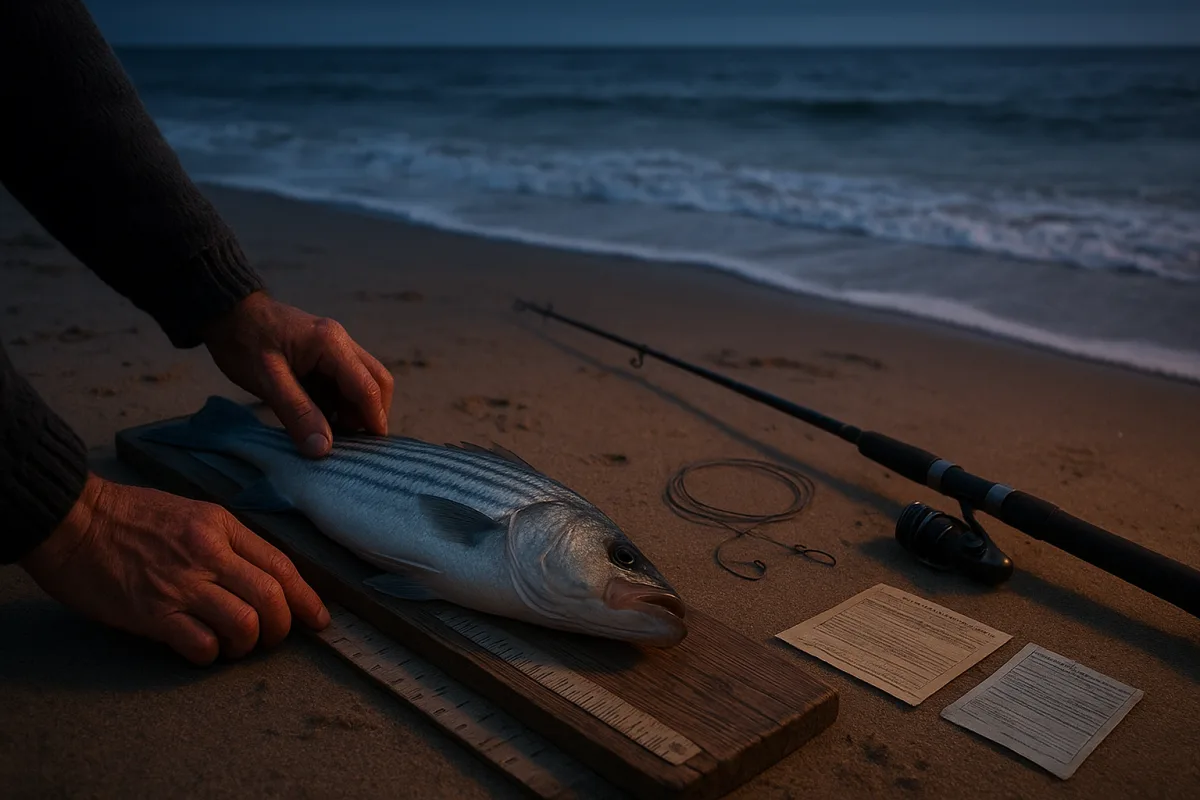
The useful way to think about surf-fishing regulations
The central compliance question is not, “Can I fish this beach?” It is, “What am I legally allowed to do with the fish I catch here, today, using this gear?” That sounds fussy until a fish is on the sand.
Surf fishing puts several regulatory systems on top of one another. The state controls recreational harvest. A park, refuge or beach authority may control access and vehicle use. Species rules then determine whether a particular fish can be retained.
That system matters because a legal cast does not guarantee a legal fish in the cooler. You may hold a valid saltwater license, stand on a public beach, fish within access hours, and still have to release every fish of a particular species.
The practical unit is therefore the possession decision. It happens after the bite, but the work must happen before the cast. If you cannot quickly identify, measure and account for the fish, release is the conservative option.
Step one: establish the place, not just the state
Start with the exact water and access point. “The coast” is often too broad for regulation purposes. A state can divide waters into marine, coastal, joint, inland, park-managed and federally managed areas, with different rules across those lines.
North Carolina’s terminology is a good example. Its coastal and joint waters have their own recreational rules, and the state requires a Coastal Recreational Fishing License for many saltwater anglers. The relevant rule is not simply the closest town’s fishing report. [2][17]
Park access can add another layer. New Jersey’s regulations require an annual surf-fishing permit for fishing at Island Beach State Park, separate from the underlying fishing requirements. The permit is about fishing in that managed park, not a substitute for statewide harvest rules. [6]
Delaware similarly treats surf-fishing access and licensing as distinct matters. Its surf-fishing permits are associated with the beach-driving and access system, while fishing-license requirements can still apply depending on the angler and circumstances. [14]
This distinction catches people who plan around a four-wheel-drive beach permit. A vehicle permit gets the truck onto the sand. It does not set the striped bass slot, legalize a closed flounder fishery or waive a required fishing license.
Public piers are another common source of confusion. California exempts anglers fishing from public piers from the ordinary sport-fishing-license requirement, but that exemption does not extend to surf fishing from the beach. Step off the pier onto the sand and the license rule changes. [15]
Private beaches, state parks, national seashores and protected coastal areas can also set access conditions beyond fish-and-game rules. Assateague Island National Seashore, for example, publishes its own surf-fishing guidance for anglers using that federally managed shore. [7]
Step two: identify the fish before applying a limit
Species identification comes before measurement. An exact length means nothing if the fish is called the wrong species. This is particularly important in the surf, where a wet fish, poor light and a hurried unhooking job make close calls easy.
The regulations are not built around broad labels such as “bass,” “drum” or “flounder.” They are built around named species. A striped bass rule does not cover a black sea bass. A red drum rule does not answer the question for black drum.
Striped bass show why the state matters more than the method. Massachusetts, New York and New Jersey allow recreational harvest within a 28 to 31 inch slot, with a one-fish daily bag limit. [3][11]
That rule does not travel south with the angler. North Carolina prohibits possession of striped bass in coastal and joint waters. A fish that would be a legal keeper under the Massachusetts, New York or New Jersey slot is still not a fish to retain there. [2][11]
That difference has a direct effect on surf-fishing preparation. In a state with a legal striped bass harvest, an angler needs a reliable measuring device and a plan to stop after one retained fish. In North Carolina coastal waters, the retention plan is release.
Flounder creates another version of the same problem. South Carolina and Florida prohibit flounder possession, while North Carolina opened a tightly limited recreational flounder season from September 1 through September 14, 2026. [1][12][19]
During that North Carolina window, the fish had to be at least 15 inches, and the daily limit was one fish. Outside the window, or below the size threshold, the fish was not a keeper. [1][19]
Texas takes a different approach, allowing flounder harvest year-round with a five-fish daily bag limit. That does not make Texas a template for neighboring coasts. It shows why “I kept five last trip” is not regulatory knowledge unless the place and date match. [4][18]
A measuring board or marked ruler is therefore compliance gear, not a convenience. Measure a fish as the applicable rule specifies, then make the decision before it spends unnecessary time in a dry bucket or on hot sand.
Step three: read season, size and bag limits as one rule
A season, a minimum size and a bag limit are not three suggestions. They form one filter. A fish must pass every relevant part of that filter before it can be possessed.
Season answers whether harvest is open today. Size answers whether this particular fish falls within the legal minimum, maximum or slot. Bag limit answers whether you may retain another fish after counting those already kept.
Slot limits deserve special attention. The 28 to 31 inch striped bass rule in Massachusetts, New York and New Jersey is not a minimum-size rule. Fish below 28 inches are outside the legal slot, but so are fish over 31 inches. [3][11]
Anglers sometimes see a larger fish as automatically better, which is understandable from a fishing perspective. Legally, an oversized fish can be just as unavailable for retention as an undersized fish. The measurement determines the outcome, not its apparent value.
Texas publishes bag and length limits for drum species, illustrating the same framework: anglers must match the fish to the named species and then apply the correct length and possession rule. [4] “Drum” is not enough information when the regulation identifies different species.
Seasonal rules can be more complicated where multiple species overlap. Washington’s 2026 bottomfish season runs from March 14 through October 17, but certain rockfish restrictions apply during May through July. A broad open season can still contain narrower species limits. [13]
For surf anglers, that means the tide chart comes after the regulation check. A clean incoming tide over a pronounced outer bar may be the best fishing window of the week. If the target species is closed, it is a catch-and-release opportunity, not a harvest opportunity.
Step four: build the rig within local gear rules
Surf rigs are regulated less uniformly than anglers often assume. The basic components, hook, leader, weight, bait and rod count, can be controlled differently from one state or location to another.
California provides a clear example. South of Pigeon Point, shore anglers face restrictions on wire or metallic leaders and may not use hooks wider than 1.5 inches. A standard shark-oriented wire-leader rig may therefore be unsuitable from the shore there. [15]
The point is not that a wire leader is always unlawful. It is that a rig should be selected after checking the exact shoreline rule. A rig that makes sense around toothy fish can still be prohibited at a particular beach.
Texas illustrates the opposite mistake: importing freshwater assumptions into saltwater. Texas limits hook counts in freshwater, while saltwater anglers may use multiple poles under the state’s rules. The water classification matters as much as the tackle. [18]
Do not try to solve an uncertain gear question with internet consensus. State agency regulations, area-specific emergency changes and posted site rules are stronger sources than a generic rig chart. California, for example, publishes in-season ocean regulation changes that can affect planning. [5]
Reporting is part of keeping the fish
In some places, possession does not end when the fish goes into the cooler. North Carolina has required reporting for flounder and other covered species since December 2025, adding a post-harvest obligation that many surf anglers may not expect. [19]
That requirement changes the mechanics of a legal harvest. The angler must not only meet season, size and bag restrictions, but also record or report the catch through the required process. A fish can be legal in size and still create a compliance problem if reporting is ignored.
This is why current rules matter more than old local advice. North Carolina’s fisheries framework is also subject to potential change following an August 2026 Wake County court ruling, although the regulatory effect remains unresolved. There is no sensible basis for guessing what may change. [20]
Check the state agency’s current page before leaving home, then check again when a trip was planned weeks ahead. Regulations can change in season, and a saved screenshot or last year’s booklet is not a reliable substitute for the active rule.
What regulations do not tell you
Regulations do not tell you where the trough is, whether the bar is holding bait, or whether a falling tide is draining a cut hard enough to concentrate fish. Those are fishing decisions, made from beach structure and current.
They also do not provide a national surf-fishing rulebook. No unified federal set of rules covers ordinary surf fishing across the country. Compliance is built from state rules, species rules and the particular beach manager’s conditions.
That is the unsentimental order of operations: identify the beach, confirm access and licensing, build a legal rig, identify the fish, measure it, check season and bag count, then handle any reporting requirement. The tide can decide when to fish. The rules decide what you may keep.
Frequently Asked Questions
Are there specific fishing regulations for surf fishing?
Yes. Surf fishing regulations are layered and vary by state, species, location, and time of year. They include species-specific size and bag limits, seasonal closures, gear restrictions, and sometimes additional permits for park or beach access. For example, California restricts wire leaders and hook sizes south of Pigeon Point, and North Carolina requires a Coastal Recreational Fishing License for many saltwater anglers.
What permits do I need for surf fishing on public beaches?
You generally need a fishing license to fish legally, but additional permits may be required depending on the location. For instance, New Jersey requires an annual surf-fishing permit for fishing at Island Beach State Park, which is separate from the state fishing license. Beach-driving permits or park access permits do not substitute for fishing licenses or species harvest rules.
How do surf fishing regulations vary by state?
Regulations differ widely by state and even within state waters. For example, Massachusetts, New York, and New Jersey allow striped bass harvest within a 28–31 inch slot limit and a one-fish daily bag limit, while North Carolina prohibits possession of striped bass in coastal and joint waters. States also vary in seasonal closures, gear restrictions, and reporting requirements.
Can I keep all fish caught while surf fishing?
No. Whether you can keep a fish depends on correct species identification, size measurement, current season, and state-specific bag and possession limits. Some species may be closed to harvest, such as striped bass in North Carolina or flounder in South Carolina and Florida. When in doubt, releasing the fish is the safest option.
Do tides affect surf fishing legal limits?
No. While tides influence fish movement and feeding times, they do not alter legal closures, slot limits, or possession bans. There are no tide-based exemptions to surf-fishing regulations. Compliance with size, season, and bag limits is required regardless of tidal conditions.
How we researched this
This article was assembled from 20 cited references.
Nothing here is based on hands-on testing. Where a figure or finding appears, it belongs to the source cited beside it, and the writing says so rather than implying otherwise. Every source is listed below so you can check it.
Sources
- Flounder fishing returns ahead of Labor Day weekend
- BLUEFISH – RECREATIONAL – COASTAL AND JOINT FISHING WATERS | NC DEQ
- Recreational saltwater fishing regulations | Mass.gov
- Drum Bag & Length Limits — Texas Parks & Wildlife Department
- In-Season Ocean Fishing Regulation Changes
- N.J. Admin. Code § 7:2-16.3 - Surf fishing | State Regulations | US Law | LII / Legal Information Institute
- Surf Fishing - Assateague Island National Seashore (U.S. National Park Service)
- New and Proposed Regulations - 2026
- NJDEP| Fish & Wildlife | New Bluefish Regulations for 2026!
- Surf Fishing Regulations by State: Licenses, Limits & Rules
- Stripedbass.org — The Striped Bass Authority
- South Carolina Finfish Size & Catch Limits | eRegulations
- Season Alert — West Coast fishing season status & alerts
- Delaware surf fishing permits and licenses, 2026
- Surf Fishing California: Regulations, Limits and What You Can Actually Keep | Creel
- Can You Keep All You Want Surf Fishing? Rules & Limits - Fishingfactor
- Outer Banks Fishing Guide | Outer Banks Surf Fishing Species | Limits & Quick Reference Guide
- Surf Fishing Port Aransas: Rigs, Bait & Best Beaches (2026…
- 2026 Fishing Rule Changes for Indian Beach Anglers | Indian Beach, NC
- New Fishing Laws & Regulation Changes Taking Effect in 2026 - Coastal Angler & The Angler Magazine
Related Articles
Surf Fishing Regulations by State: Licenses, Limits & Rules
Learn surf fishing regulations by state, including licenses, gear rules, seasonal limits, and local restrictions for a legal fishing trip.
How to Catch Fish During a Beach Bonfire: Tips and Safety
Learn how to catch fish during a beach bonfire with tips on tides, gear setup, safety, and legal regulations for a successful surf fishing night.
Interpreting Surf Fishing Conditions: Waves, Wind & Tides
Learn how to interpret surf fishing conditions like waves, wind, and tides to improve your beach fishing success and safety.
Best Surf Fishing Setup for Fall: Gear, Rigs & Tides Guide
Discover the best surf fishing setup for fall with gear, rigs, and tips on reading tides and beach structure for successful autumn fishing.