Best Surf Fishing Setup for Fall: Gear, Rigs & Tides Guide
Discover the best surf fishing setup for fall with gear, rigs, and tips on reading tides and beach structure for successful autumn fishing.
The shift is from a summer setup to a conditions-matched fall setup
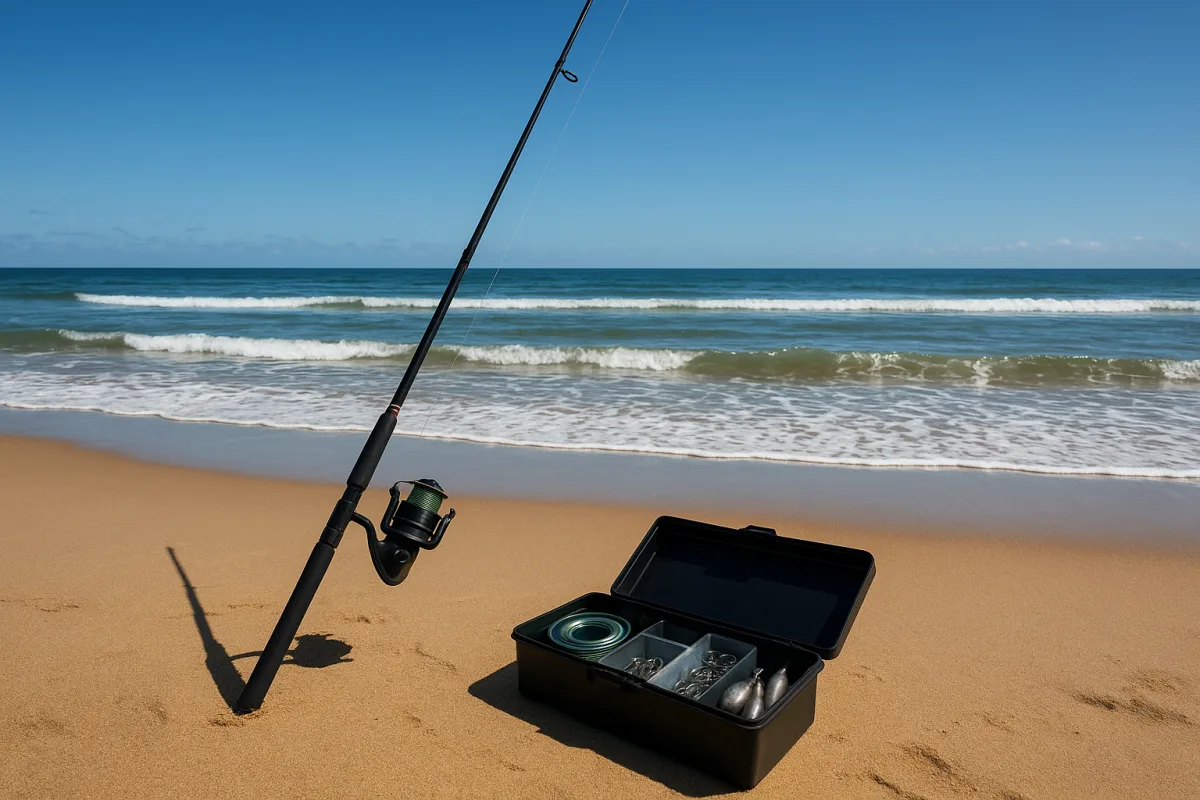
The practical shift in fall is plain: the best surf fishing setup is no longer one rod, one sinker, and one casting distance used everywhere. Successful fall fishing becomes a matching exercise between water movement, beach structure, migrating bait, and the species using it.
Several independent guides arrive at that same conclusion from different directions. Rod guidance favors more reach and casting control, rig guidance emphasizes sinker weight and leader length, and seasonal advice repeatedly points anglers toward moving bait, tide windows, and nearshore structure. [1][6][19]
That agreement matters more than any claim that one rig is universally best. The evidence does not support a single fall surf setup that works equally well for striped bass, bluefish, red drum, spot, flounder, California surf perch, and Gulf pompano.
What changes in fall is not simply the calendar. Baitfish move, water cools, and predators often concentrate along channels, troughs, and cuts where current carries forage. An angler still fishing featureless water with a summer rig can make perfect casts to empty water. [17][19]
For a general East Coast or Gulf starting point, the strongest consensus is a 10 to 11 foot medium-heavy surf rod with a moderate-fast or fast action, a 5000 to 6000 size reel, and 20 to 30 pound braid. [1][3][13]
That is a starting point, not a shopping list disguised as advice. Moderate-fast and fast actions are both recommended in the available research, with the choice turning on whether the angler needs more load for distance or more tip sensitivity. [1]
Why the standard fall rod gets longer and stronger
A 10 to 11 foot rod is the all-around fall compromise because it handles a useful range of sinkers, lifts line above shore break, and still casts plugs or bait without becoming cumbersome. Knots.fish identifies that length as the broad fall sweet spot. [1]
The broad recommendation also reflects how fall fish are commonly approached. You may need to hold cut bait in a channel one tide, then cast a spoon across a bar edge the next. A rod that cannot manage both jobs narrows your options.
For plugging, a nine foot rod is often the better tool. Monterey Beach Resort’s rod guide separates that shorter length for lure casting from 11 to 12 foot rods intended to maximize distance when throwing chunk bait. [2]
For bait fishing where distance genuinely matters, an 11 or 12 footer makes more sense. That does not mean every cast should go to the horizon. Fish regularly feed in the first trough, and overcasting beyond the feeding lane is a documented surf-fishing mistake. [19]
Medium-heavy power covers most autumn work with standard sinkers, plugs, and common bait rigs. Move to heavy power when large striped bass or bluefish are the clear target, particularly where heavier sinkers, larger chunks, or stronger current demand more backbone. [1][3]
The research does not establish a single best rod model, brand, or exact reel model. That is an important gap, especially for readers expecting a product comparison. The available evidence supports tackle categories and specifications, not model-specific recommendations.
Line, leader, and sinker weight should follow the water
Braid in the 20 to 30 pound range is the logical general main line for fall surf fishing because its thin diameter helps casting distance while retaining useful strength. Mono in 15 to 20 pound test remains relevant where stretch and shock absorption help. [4]
Fluorocarbon belongs mainly at the leader end rather than filling the whole spool. For a Fish Finder rig, Knots.fish specifies a 24 to 36 inch fluorocarbon leader in 40 to 60 pound test, a sensible range around rough mouths and abrasion. [1]
That heavier leader is not a reason to use it indiscriminately. It suits bait rigs for larger, toothier, or structure-oriented fish. Lighter regional targets and clearer, gentler water can require a more restrained approach, though exact West Coast fall leader formulas are poorly documented.
Sinker weight is the part of the setup that should change most often during a session. Frank and Fran’s Bait and Tackle recommends two to three ounces in calm conditions, three to four ounces normally, and four to five ounces in moderate current. [6]
When current becomes strong, that same Hatteras guidance moves to five to six ounces, then six to eight ounces or more in very strong water. The point is holding bottom without using so much lead that casting and bite detection become clumsy. [6]
A rough line-to-sinker relationship also helps prevent mismatched tackle. Surfcasting Republic advises line strength around twice the sinker weight, offering four to six ounce sinkers with roughly 17 to 30 pound test line as an example. [4]
Read that as a baseline rather than a rule that overrides species. Larger fish can justify 30 to 50 pound braid or heavy mono, according to CNY Fishing, while small surf species do not require bulldog tackle simply because autumn has arrived. [5]
Rig choice follows the target, not the season alone
A Fish Finder rig is the general bait setup when fall predators may pick up a moving bait and run. Its sliding sinker arrangement and 24 to 36 inch leader suit cut mullet, surf clams, sand crabs, or other substantial offerings. [1][13]
Use cut mullet when targeting red drum, a combination supported by One Outdoors’ general surf guide. On East Coast beaches, West Marine also lists surf clams, sand crabs, and cut mullet among standard offerings for the region’s surf and jetty fish. [7][13]
For smaller bottom feeders such as spot, a high-low rig is more efficient than a large single-hook bait rig. One Outdoors specifies 18 to 24 inch leaders with hooks spaced eight inches apart, allowing two compact baits in the feeding zone. [7]
Bloodworms and shrimp are the appropriate spot baits cited by Outer Banks Surf Fishing. That is not a rig to force on a bluefish run, where the objective is usually to intercept active predators rather than wait for small fish to graze. [8]
Circle hooks deserve attention in every bait setup. Shore Guide identifies dull hooks as a common failure and recommends circle hooks with frequent sharpening or replacement, which is more useful advice than treating hook selection as an afterthought once rods are deployed.
Lures work when bait is moving through reachable water
Fall lure fishing is strongest when birds, bait, current seams, or visible surface activity tell you where predators are traveling. Blindly walking a metal lure across flat, lifeless water can cover ground, but it does not solve the location problem.
For bluefish, Outer Banks Surf Fishing recommends one to two ounce metal spoons, including the Stingsilver. Slow retrieves with pauses are the general presentation guidance, giving a fleeing-bait profile without racing a lure above the fish. [12]
Bucktail jigs are another fall option for striped bass and bluefish. One Outdoors recommends steady or stop-and-go retrieves, which makes sense around trough edges and current seams where a jig can stay near the level of moving forage. [7]
Three to five inch soft-plastic swimbaits suit halibut and striped bass, according to Red Sky Surf Hunters. Work them slowly with pauses, especially when fish are holding close to bottom contours rather than blitzing visibly on top. [9]
None of these lures is a cure for bad timing. Bluefish are particularly associated with spring and fall migrations and are most active in early morning and evening, while striped bass favor low light and moving water. [10][12]
Tide charts decide the plan before the rod comes out
For striped bass, the recurring recommendation is moving water, with the final hour of incoming or outgoing tide especially productive. Fishing Reports Today and Master Fishing Mag both identify current flow, rather than slack water, as the primary condition to seek. [10][11]
The biological reason is straightforward. Moving water shifts bait through channels and along bar edges, giving bass a predictable interception point. A Fish Finder rig in a cut or a bucktail worked along the seam has a purpose there.
Water temperature narrows that striped bass window further. Master Fishing Mag places active feeding between 50 and 70 degrees Fahrenheit, noting that bass slow below 50 degrees and move offshore above 70 degrees. [11]
Bluefish planning is similarly tide-aware but often more visibly bait-driven. Fish dawn and dusk during a fall migration, then look for diving birds, bait pushed tight to the beach, or a current rip cutting through a bar. [12]
Flounder are the exception that proves why a one-rule tide plan fails. Shore Guide identifies slack tide as the better period for bottom-feeding flounder, so an angler rigidly waiting for maximum current may miss the appropriate window entirely.
Read the beach before changing tackle
The structure hierarchy is simple: find a trough, then find the cut or low section that connects it to deeper water, then determine where current carries bait across that feature. That is a more useful plan than choosing a sinker by habit.
Fishing World Guide specifically warns against fishing areas that lack troughs, cuts, and sandbars. The fall setup works because it places bait or lures where fish can use those features, not because a medium-heavy rod has any inherent magic. [17]
Start by watching wave behavior from a higher point on the beach. A consistently darker, smoother lane can indicate deeper water, while a gap in an outer line of breaking waves can mark a cut through the bar.
Then make the short cast first. Put a bait in the inside trough, another near the channel edge if permitted by your local rules and rod count, and only cast farther when the visible structure supports it. Overcasting is a recurring mistake. [19]
If the surf is too rough to hold a bait with practical lead, or if no trough, cut, bait, birds, or current seam is visible, conditions may simply not produce. Changing to heavier gear does not create fishable water.
Regional adjustments are not optional details
East Coast fall surf fishing most closely fits the general recipe: 10 to 12 foot medium-heavy rods, 5000 to 6000 reels, 20 to 30 pound braid, and 40 to 60 pound leaders. Fish Finder, dropper-loop, and Carolina rigs all appear in West Marine’s regional guidance. [13]
On the Gulf Coast, rod and reel dimensions may resemble East Coast equipment, but the target mix changes the job. Fishing.digital points to shrimp, cut mullet, and crab, with redfish targeted at dawn and pompano during migration periods. [16]
California is the clearest warning against importing an East Coast setup unchanged. Cal Coast Tides describes seven to 10 foot rods, lighter line for surf perch, and heavier options for rockfish or lingcod, with species-specific tide timing. [15]
The research is thinner on detailed fall rigs and beach-reading systems for the West and Gulf coasts than it is for Eastern surf fishing. Local tackle shops, current local reports, and experienced beach anglers are worth consulting before copying an Atlantic rig.
The fall trend, then, is not toward more equipment. It is toward more deliberate matching. Check the tide chart, forecast surf height and wind, locate the feeding lane, identify the likely species, and choose rod length, sinker, rig, bait, and retrieve from that information.
Frequently Asked Questions
What is the best surf fishing setup for fall conditions?
A good fall surf fishing setup typically includes a 10 to 11 foot medium-heavy rod with moderate-fast or fast action, paired with a 5000 to 6000 size reel and 20 to 30 pound braided line. This setup offers a balance of casting distance, sensitivity, and strength suitable for a variety of species and conditions. However, adjustments are necessary based on local species and coast, as no single rig fits all fall surf fishing scenarios.
How do I adjust my surf fishing gear for fall tides and species?
In fall, fish concentrate along channels, troughs, and cuts where currents carry bait, so anglers should match sinker weight to current strength and target specific beach structures rather than casting blindly beyond the outer break. For moving-water species like striped bass and bluefish, fish near tide turns, while slack water is better for flounder. Adjust rod length, sinker size, and leader length according to the species and local conditions.
What rod and line are recommended for surf fishing in the fall?
A 10 to 11 foot medium-heavy rod with moderate-fast or fast action is recommended for general fall surf fishing, providing enough length for casting distance and control. Braided line in the 20 to 30 pound range is preferred for its strength-to-diameter ratio and casting ability, with a heavier leader (40 to 60 pounds) to handle larger fish and abrasion.
How do I read beach structure and tides for fall surf fishing?
Focus on the structure created by tides such as troughs, cuts, and the inside edges of sandbars, since these areas concentrate bait and predators in fall. Avoid casting automatically beyond the outer break; instead, observe where baitfish and current converge. Timing sessions around tide turns can improve success for species like striped bass and bluefish, while slack water suits flounder fishing.
Which sinker weights work best for fall surf fishing?
Sinker weight should be matched to current strength: 2–3 oz for calm conditions, 3–4 oz for normal current, 4–5 oz for moderate current, 5–6 oz for strong current, and 6–8+ oz for very strong current. Adjusting sinker size helps maintain bait position and stability in varying water movement typical of fall surf fishing.
How we researched this
This article was assembled from 19 cited references.
Nothing here is based on hands-on testing. Where a figure or finding appears, it belongs to the source cited beside it, and the writing says so rather than implying otherwise. Every source is listed below so you can check it.
Sources
- Best Surf Fishing Rods - Fishing Gear Guide | knots.fish
- 8 Best Surf Fishing Rods (September 2026)
- The Complete Guide to Surf Fishing Setups — Rod & Reel
- What Line to Use for Surf Fishing? | The Real Setup
- What Lb Test for Surf Fishing: Make Every Cast Count - CNY Fishing
- Surf Fishing Sinkers Explained: What Type and Size Should You Use on Hatteras Island? - Frank & Fran's Bait and Tackle
- Surf Fishing Guide: Rigs, Baits, Best Beaches & Techniques | One…
- The OBX Spot Run: When It Hits, Bait, Rigs & Limits
- Soft Plastics: / Surf Fishing Gear: Lures / Surf Fishing Gear / Gear Shop | Red Sky Surf Hunters
- How To Catch Striped Bass: Complete Guide To Techniques, Gear, And Locations | Fishing Reports Today
- Why Most Surf Anglers Miss Striped Bass by 20 Feet
- Surf Fishing for Bluefish 7 Tips for Tackling these Aggressive and Hard Fighting Fish - The Beach Angler
- Surf, Jetty & Kayak Fishing Guide: Gear, Techniques & Tips | West Marine
- Surf Fishing Guide: How to Catch Fish from the Beach — The Fishing Manual
- Surf Fishing Gear Guide: Essential Equipment for California Beaches | Blog
- Gulf Coast Surf Fishing Guide — Redfish, Pompano & Sharks
- Surf Fishing 2026 — Catch More from Shore | FishingWorldGuide
- Common Surf Fishing Mistakes and How to Avoid Them
- Surf Fishing for Beginners: Gear, Rigs & Timing
Related Articles
Best Surf Fishing Setup for Summer: Rods, Rigs & Tides
Discover the best surf fishing setup for summer, including rods, rigs, tides, and beach reading tips for successful fishing sessions.
Best Surf Fishing Setup for Night Fishing: Rods, Rigs & Gear
Learn the best surf fishing setup for night fishing including rods, rigs, line, and tips for effective bait placement and tide timing.
How to Prepare for a Surf Fishing Trip: Gear, Tides & Tips
Learn how to prepare for a surf fishing trip with tips on gear, tides, beach reading, and safety to ensure a successful fishing day.
Surf Fishing Techniques for Flounder: Rigs, Tides & Tips
Learn the best surf fishing techniques for flounder including rigs, tides, and how to read the beach for successful catches.