
Best Surf Fishing Setup for Night Fishing: Rods, Rigs & Gear
Learn the best surf fishing setup for night fishing including rods, rigs, line, and tips for effective bait placement and tide timing.
The best night setup is a controlled presentation system
The useful way to think about night surf fishing is not as daytime surf fishing with a headlamp. It is a system for putting bait or a lure in a specific piece of moving water, then detecting a take without seeing the line.
That system begins with the beach, not the tackle shop. At night, the productive cast is often the one landing in the nearest trough, along a cut, or beside a point where current collects baitfish. [14]
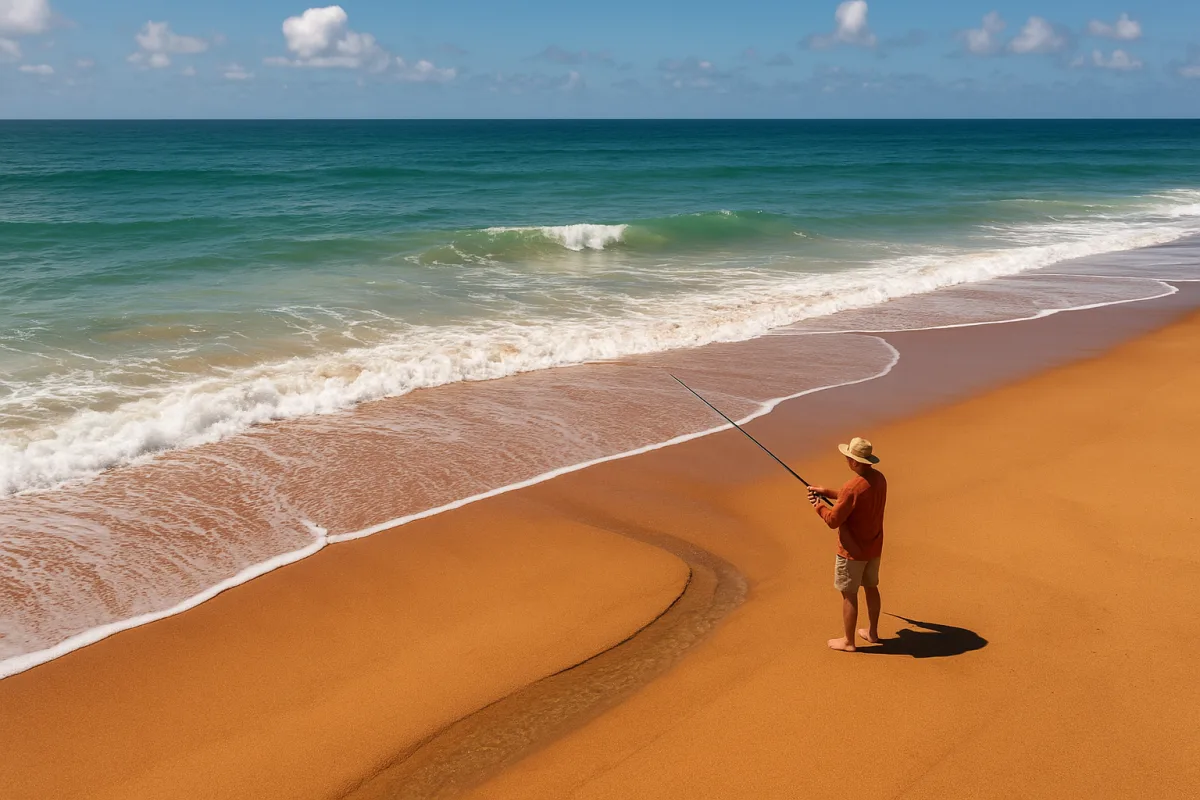
A trough is the deeper channel running parallel to the beach. A cut is a break in an outer bar where water drains seaward. A point alters the sweep of current, and often forms an edge between calmer and faster water.
Those places matter because predators do not need to search the entire surf. Current delivers disoriented bait into a confined lane, while deeper water offers a travel route. Your rig needs to hold there long enough for fish to find it.
That is why “cast as far as possible” is a poor night-fishing rule. FishingWorldGuide identifies troughs, cuts, and points as fish-concentrating structure, and notes that casting distance and sinker weight should be adjusted to the structure rather than treated as fixed. [14]
A long cast beyond the bar can be right when the active water is outside. It is wasted effort when bait and feeding fish are in the inside trough, especially when darkness makes accurate placement and line management harder.
Match the rod to the water you must control
There is no evidence in the research brief for a rod specification unique to night fishing. The sensible approach is to adapt general surf-rod dimensions to what must be cast, the weight needed to hold bottom, and the room available behind you.
For most anglers walking a beach after dark, a 10 to 11 ft rod is the workable middle ground. Knots.fish and Battlbox both describe that range as balancing casting ability with manageability. [1][2]
That manageability is not a trivial comfort issue. A shorter, controllable surf rod is easier to carry between cuts, easier to keep clear of other lines, and less awkward when landing a fish in wash you cannot fully see.
A 12 to 15 ft rod increases casting reach, which can matter where an outer bar or strong sweep requires more distance. The tradeoff is reduced maneuverability, a meaningful cost when you are moving along uneven sand in the dark. [1][2]
Power should follow sinker load and expected fish, not the clock. Knots.fish places medium-heavy rods in the range for 2 to 4 oz sinkers and 15 to 25 lb line, while heavy rods suit 3 to 6 oz sinkers and 20 to 40 lb line. [1]
For striped bass or red drum in current, a heavy rod is often the more coherent choice if you need a substantial sinker to keep bait in the feeding lane. A rod that cannot carry the required weight leaves the bait drifting uselessly.
Moderate-fast action is the practical general recommendation because it preserves enough tip sensitivity to register a pickup while retaining casting performance. [1] There is no detailed evidence that a different action becomes objectively better merely because the sun has set.
Braid, leader, and knot form one working unit
The line system determines whether a fish can take the bait, whether the sinker remains where you put it, and whether you can land the fish through abrasive surf. It also determines whether you can cast cleanly.
For striped bass and red drum, Fishing Line Guide recommends 30 to 40 lb braided main line. [3] Braid’s value in this system is its relatively direct connection to the rig, which helps transmit a bite and lets a given spool hold substantial line.
The leader performs a separate job. It takes abrasion from sand, shell, rough mouths, and the repeated surge of a fish in shallow water. Common guidance is a 2 to 4 ft leader rated at roughly 1.5 to 2 times the main line’s strength. [3][4]
That conventional leader length is not an instruction to make every leader long. Gadgetsfeed cautions that a long leader joined with a bulky knot can interfere with casting, and suggests that leaders under nine inches may sometimes improve efficiency. [17]
The apparent disagreement is really about rig design. A longer leader can place the bait farther from terminal hardware and provide abrasion margin. But if the joining knot repeatedly catches the guides, the cast loses distance, accuracy, and reliability.
Use the shortest leader that still protects the line and presents the bait properly in your local surf. If a 2 to 4 ft leader casts cleanly and the water or fish demand abrasion resistance, it is sensible. If the knot is causing trouble, shorten and refine.
This is also where regional assumptions fail. On the Outer Banks, OneOutdoors describes a night-oriented bull red drum setup using a 10 ft rod, 5000-size reel, 20 lb braid, and a fish-finder rig, with a quoted setup cost of $150 to $250. [5]
That $150 to $250 figure is a regional setup estimate, not a universal night-fishing price. It does not establish that 20 lb braid is adequate for every beach, current, species, or sinker requirement, particularly where larger fish and abrasive structure are involved.
California surf fishing calls for a different range of tools. Red Sky Surf Hunters lists 8 to 12 ft saltwater rods, 4000 to 6000 series reels, and 15 to 30 lb line, with spoons, soft plastics, topwater plugs, and bucktail jigs among the relevant lures. [13]
Let tide choose the session, then let structure choose the cast
A rig works only if fish are using the water it occupies. Tide movement is the practical trigger because moving water transports bait and changes the depth and current speed over bars, troughs, and cuts.
The Emerald Coast Guide identifies the first two hours of an incoming tide and the first hour of an outgoing tide as productive windows. It also recommends fishing the two hours before and after high tide. [12]
These are overlapping guides, not a promise that any beach will switch on at a precise minute. The point is to arrive when water is changing, observe where it is cutting or filling, and place the rig where that movement meets depth.
The first two hours after sunset are commonly recommended, but the sources do not establish a universal best period. It can be excellent because low light coincides with the start of a tide window, but darkness alone does not manufacture feeding activity.
On the Outer Banks, OneOutdoors reports that 40 to 50 lb bull red drum feed in the wash zone after dark from September through November. [5] That is a strong reminder to fish the near water before committing to a distant cast.
Light to moderate surf is generally easier to fish effectively than heavy, disorganized water. [14] When the surf is so rough that a sinker will not hold, the line bows uncontrollably, and the wash obscures safe footing, better tackle does not fix the session.
Bait and lures must give fish something to locate
At night, use offerings that create a detectable target in moving water. OneOutdoors identifies fresh-cut mullet, live shrimp, live eels, and chunk bunker as effective surf baits after dark. [5]
The common feature is not a magic bait species. These baits offer scent, bulk, and natural movement, allowing fish to find them without depending entirely on sight. Keep them where current delivers them, rather than constantly recasting into new water.
For artificial presentations, dark colors are a rational starting point. WeBoating, Cast and Spear, and Shannons Fishing recommend black, dark purple, and dark blue lures, along with paddle-tail swimbaits, topwater poppers, and stickbaits. [6][7][8]
Retrieve them slowly enough to remain in the strike zone. Fishing Central Australia and Rod & Reel both emphasize slow presentation and lures that produce vibration, noise, or surface disturbance, which give fish cues beyond color. [9][18]
A dark lure is not automatically productive in dead water. If there is no bait, no current edge, or no fish using the trough, changing from black to purple is a minor adjustment to a fundamentally poor location.
Lighting should preserve your eyes, not light the whole beach
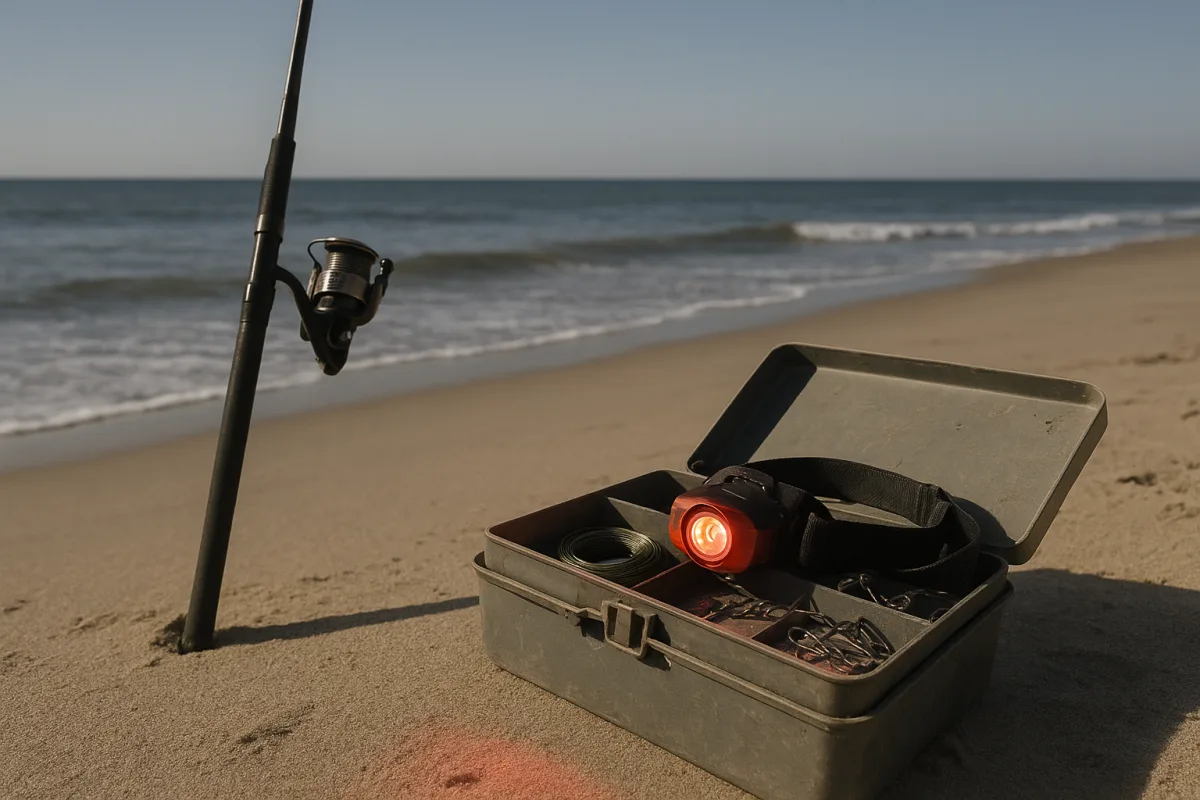
A headlamp is part of the fishing system because it determines whether you can tie knots, rebait safely, and see a wave line without destroying your adjusted night vision. Red mode is preferable for routine work.
Fenix Store explains that red light preserves night vision and is less disruptive to fish than bright white light. [11] Use white light for safety-critical tasks, such as crossing rocks, finding an access path, or dealing with a hook in clothing.
FishDojo lists the Black Diamond Spot 400-R at about $80. It provides 400 lumens, IP67 waterproofing, and red mode, making it the better-specified option for anglers who expect rain, spray, or repeated wet-sand exposure. [10]
FishDojo also lists the BioLite Range 500 at about $70. Its 500-lumen output, IP67 rating, and red mode suit anglers who want more available white-light output while retaining a low-impact mode for tying rigs and checking bait. [10]
For a lower-cost option, FishDojo lists the Petzl Tikka at about $30. It offers 300 lumens, red mode, and water resistance, which suits calmer conditions but is not presented as having the IP67 protection of the first two models. [10]
The Foxelli Rechargeable, listed at about $25 by FishDojo, provides 200 lumens, red mode, and rechargeable power. It suits budget-minded anglers who need basic task lighting, though its lower output makes it less compelling for long, exposed walks on unlit beaches. [10]
These are reported specifications and prices from FishDojo’s 2026 guide, not personal product testing. Prices can change, and none of these headlamp prices includes spare batteries, a charging system beyond what may be supplied, or other night-safety equipment. [10]
Rod-tip lights are often mentioned as a night-fishing convenience, but the research does not identify specific models with verified specifications and prices. Treat them as optional, and choose only waterproof, lightweight units with adjustable brightness that do not overload the tip.
Finally, protect the system after the trip. Saltwater exposure is hard on reels, and AllFishers specifically warns against non-sealed reels in harsh saltwater conditions. [16] Rinse and maintain the reel, then replace damaged leader before the next tide window rather than discovering it during one.
Frequently Asked Questions
What is the best rod and reel setup for night surf fishing?
A 10 to 11 ft moderate-fast action rod is generally the most manageable and versatile choice for night surf fishing. Medium-heavy power suits sinkers of 2 to 4 oz and 15 to 25 lb line for smaller species, while heavy rods handle 3 to 6 oz sinkers and 20 to 40 lb line for larger fish like striped bass and red drum. Longer rods (12 to 15 ft) increase casting distance but reduce maneuverability, which can be a disadvantage in the dark.
How do I rig my surf fishing gear for night fishing?
Night surf fishing rigs should focus on placing bait or lures in specific current structures such as troughs, cuts, or points where baitfish concentrate. Adjust sinker weight and casting distance to hold the bait in these feeding lanes rather than casting as far as possible. The rig must hold position in moving water long enough for fish to find it, so sinker weight and leader length should be suited to the local conditions and rig type.
What line and leader strength should I use for night surf fishing?
For larger surf species like striped bass and red drum, 30 to 40 lb braided main line is recommended due to its strength and sensitivity. Leaders typically range from 2 to 4 feet in length and should be abrasion-resistant, with test strength about 1.5 to 2 times that of the main line to withstand sand, shell, and fish mouths. Leader length should also consider knot bulk and casting performance.
How do tides affect night surf fishing setups?
Fish tend to be most active in moving water during the first two hours of an incoming tide, the first hour of an outgoing tide, and the two hours around high water. Positioning your rig in troughs, cuts, or points where current concentrates baitfish during these tidal periods improves chances of success. Adjust sinker weight and rig placement to hold bait effectively in these dynamic water conditions.
What lighting is recommended for surf fishing at night?
Use red lights only when handling gear to minimize spooking fish. A waterproof headlamp is preferred over rod-tip lights, as the research does not identify reliable rod-tip light models or specifications. The headlamp should be lightweight and have adjustable brightness to suit different tasks without impairing night vision.
How we researched this
This article was assembled from 18 cited references.
Nothing here is based on hands-on testing. Where a figure or finding appears, it belongs to the source cited beside it, and the writing says so rather than implying otherwise. Every source is listed below so you can check it.
Sources
- Best Surf Fishing Rods - Fishing Gear Guide | knots.fish
- What Rod to Use for Surf Fishing? Best Gear Guide - Battlbox.com
- Surf Fishing Line Setup: Braid, Leader & Rig Guide
- What LB Fishing Line Do You Need For Striped Bass? - Center of Outdoor
- Surf Fishing Guide: Rigs, Baits, Best Beaches & Techniques | One…
- Night Fishing Tips: Gear, Techniques & Safety | WeBoating
- Night Surf Fishing: A Complete Guide to Catching Monsters After Dark
- Are Lures Good at Night? Best Night Fishing Lures That Actually Work - Shannons Fishing
- Night Fishing Setup: Rods, Reels & Lighting Gear — Rod & Reel
- Best Fishing Headlamps 2026 | FishDojo
- Best Lights for Night Fishing 2026 | Fenix-Store – Fenix Store
- Surf Fishing the Emerald Coast: A Beginner's Guide (2026)
- Surf Fishing Gear : Tackle / Surf Fishing Gear / Gear Shop | Red Sky Surf Hunters
- Surf Fishing 2026 — Catch More from Shore | FishingWorldGuide
- Surf Fishing Mistakes: 5 Habits You Need to Break
- Striped Bass Fishing Gear: Surf, Boat & Kayak
- How to Rig a Surf Fishing Rod | Three Rigs That Actually Catch Fish
- Night Fishing in Australia: Tactics, Gear, and Safety for Low‑Light Se – Fishing Central Australia
Related Articles
Best Surf Fishing Setup for Summer: Rods, Rigs & Tides
Discover the best surf fishing setup for summer, including rods, rigs, tides, and beach reading tips for successful fishing sessions.
How to Catch Fish During a Beach Bonfire: Tips and Safety
Learn how to catch fish during a beach bonfire with tips on tides, gear setup, safety, and legal regulations for a successful surf fishing night.
Surf Fishing Gear Checklist
Get a practical surf fishing gear checklist focused on rigs, sinkers, rods, and packing tips for effective fishing during your chosen tide window.
How to Find Fish in the Surf: Reading the Beach & Tides
Learn how to find fish in the surf by reading tides, water features, and beach structure for better surf fishing success.