
Surf Fishing Gear Checklist
Get a practical surf fishing gear checklist focused on rigs, sinkers, rods, and packing tips for effective fishing during your chosen tide window.
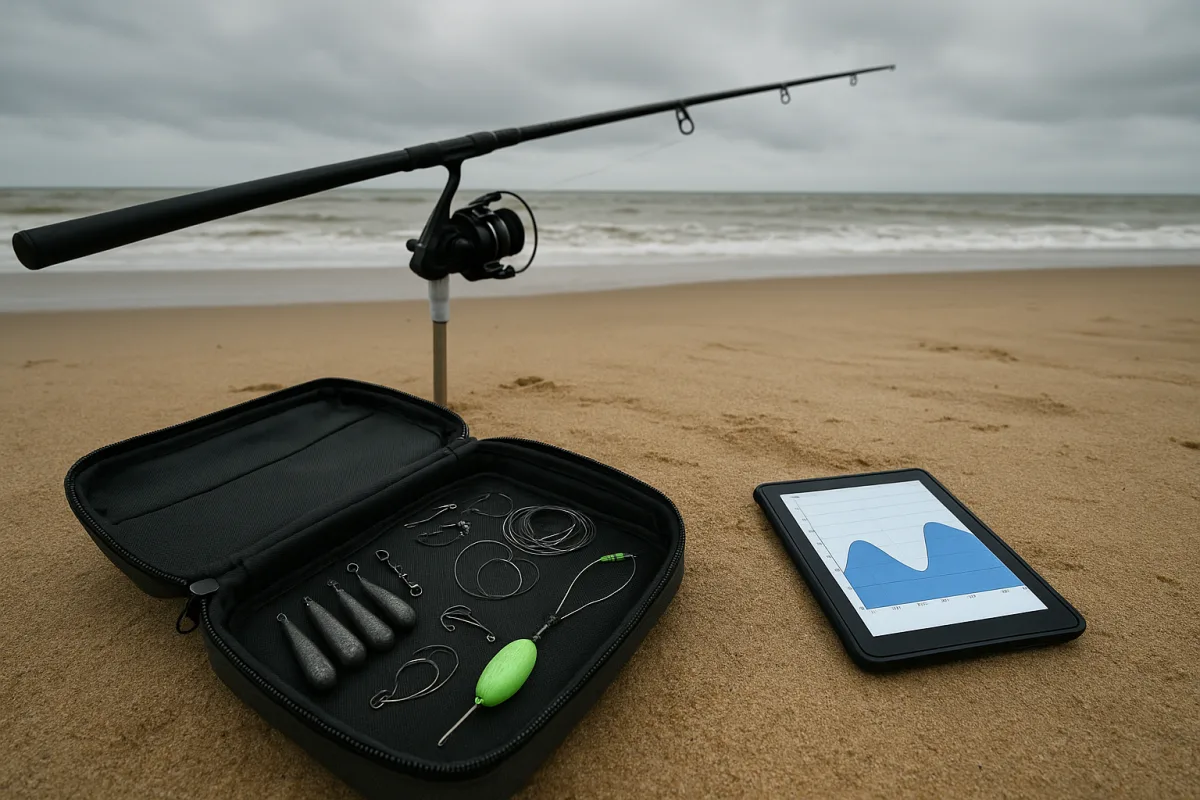
The checklist is really a rig-replacement system
A useful surf-fishing gear checklist is not a catalog of equipment. It is a system for keeping one bait fishing effectively through a tide window, despite abrasion, weed, changing current, lost sinkers and hook damage.
That distinction matters because surf fishing is governed by the water in front of you. A beautifully organized bag does nothing if the sinker rolls down-current, the bait lies outside the trough, or the leader is too light for sand, shells and rocks.
Start with the question that determines the rest of the packing: what must remain functional until the tide changes? Usually that means one casting outfit, one working fish finder rig, and enough replacements to recover from predictable losses.
The fish finder rig is a sensible center point because it separates the job of holding bottom from the job of presenting bait. Knots.fish describes the standard arrangement as a sliding sinker, barrel swivel, leader and circle hook. [1]
The main line passes through the sliding sinker attachment. The sinker can sit on the bottom while a fish moves off with bait, then the line transfers pressure through the swivel, leader and hook.
That is the mechanical reason to pack the components separately rather than carrying a single completed rig. A broken leader should cost a leader and hook, not the whole session. A lost sinker should take seconds to replace.
For a planned high-tide session, organize terminal tackle into three groups: hooks for the bait, leaders for the structure, and sinkers for the current. Those are the consumables that decide whether your rod is fishing or merely standing in a holder.
Begin with the tide chart, not the tackle shop
FishingWorldGuide’s general guidance puts the productive period around two hours before and two hours after high tide. [2] That is not a guarantee of fish, but it is a practical packing boundary.
Moving water can push bait through troughs and cuts, and high water lets fish work closer to the beach. By contrast, FishingZenith identifies slack tide as a common beginner mistake because reduced water movement can reduce catch rates.
If high tide falls at 6:15 a.m., the practical plan is a roughly 4:15 to 8:15 a.m. session, with the most important tackle already assembled before the light improves. Do not waste that period tying every leader from scratch.
Dawn and dusk are widely treated as prime surf-fishing periods, including in FishingWorldGuide and California Coast Tides guidance. [2][7] When low light overlaps a moving tide, pack lighting and tackle organization as fishing gear, not optional comforts.
A headlamp lets you re-rig without putting hooks in the sand or losing small swivels. Keep it accessible with the pliers, line cutter and spare leaders, rather than buried under food and spare clothing.
The tide chart also tells you what not to carry. If you will fish a calm West Coast beach for a short morning flood, an oversized assortment of heavy East Coast pyramid sinkers adds weight without solving a likely problem.
Pack the rod and reel as a matched casting system
The rod, reel and main line are one system. The rod must cast the sinker weight, the reel must hold sufficient line and provide useful drag, and the line must tolerate repeated casts through saltwater and sand.
General surf tackle guidance commonly points to 10- to 12-foot medium-heavy or heavy rods. [1] That is a starting category, not a universal answer, because rod length is dictated by species, beach conditions and regional practice.
For striped bass, New England Angling recommends an 8- to 10-foot medium-heavy rod and 20- to 30-pound braided main line. [3] This is a more compact setup than the long-rod approach often associated with open East Coast beaches.
For red drum, Reel Gear Guide recommends 10- to 12-foot heavy-power rods paired with 6000- to 8000-size spinning reels. [4] That heavier category reflects larger bait, heavier sinkers and the need to control powerful fish in current.
FishingWorldGuide describes a different East Coast pattern: 12- to 15-foot rods, 8000- to 12000-size reels, 15- to 25-pound monofilament main line and 50- to 80-pound shock leaders. [2] Pack that system only if it fits your local fishing.
Red Sky Surf Hunters outlines a lighter West Coast tendency, with 8- to 12-foot rods, 4000- to 6000-size reels, 20- to 30-pound braid and lighter sinkers. [6] Species, surf energy and casting demands are different.
The checklist rule is simple: pack one outfit that covers the sinker range you expect to use. Do not bring a rod rated for light weights if the forecast and tide require a sinker heavy enough to hold a baited rig.
Sinkers are the first item that exposes a bad plan
A sinker does not exist to make a cast longer. Its primary job is to hold the bait in a feeding lane long enough for a fish to find it. If it cannot hold, every other tackle choice is secondary.
Pyramid sinkers in the 2- to 8-ounce range are widely recommended for surf fishing because their shape grips sand in moving water. [11] FishingWorldGuide specifies 4- to 6-ounce pyramids as common in its East Coast setup. [2]
West Coast surf fishing can call for much less lead. Red Sky Surf Hunters gives a 1/4- to 4-ounce range, reflecting calmer water at times and smaller-target applications. [6] This is why a universal “surf sinker kit” is misleading.
Pack at least a small progression of weights around the forecasted requirement. If four ounces is likely to hold, carry lighter and heavier options as well, because current strength, sweep and the depth of the trough can differ across one beach.
Do not interpret a rolling sinker as a reason to cast farther. First move along the beach and look for a trough, cut or sheltered side of a point where the water gives the rig a chance to settle.
FishingWorldGuide warns that ignoring troughs, cuts and points produces poor results. [2] A checklist should therefore include enough mobility to relocate, not so much equipment that moving 100 yards becomes a chore.
Leaders and hooks are bait-specific decisions
The leader is the sacrificial connection between fish, bait and the abrasive bottom. It should be selected for structure and target fish, not merely matched automatically to the breaking strength of the main line.
For striped bass, Farmers’ Almanac and Surfcasting Republic guidance in the research brief favors 3- to 4-foot fluorocarbon leaders in the 40- to 60-pound range. The stated reasons are abrasion resistance and reduced visibility.
That is markedly heavier than the 30- to 40-pound monofilament leader suggested in general surf gear guidance from Knots.fish. [1] Neither figure is wrong. The appropriate choice depends on what can rub the leader and what is likely to take the bait.
Pack leaders pre-cut and labeled by strength. A practical rig wallet might hold lighter leaders for clean sand and smaller species, plus heavier leaders for rough ground, bigger bait or places where shells and rocks make break-offs routine.
Circle hooks should be packed to fit the bait, not selected solely by target fish names. OneOutdoors gives a broad 1/0 to 8/0 circle-hook range, with 5/0 to 8/0 sizes for bigger baits and larger species. [11]
FishingWorldGuide’s East Coast baseline is smaller, 2/0 to 4/0 circle hooks. [2] That makes sense for common bait-and-species combinations there, while a larger chunk bait needs a larger hook to leave enough gap for a clean set.
Carry fresh hooks in a waterproof compartment and discard damaged points. Cast and Spear identifies inadequate tackle and dull hooks among the errors that cost beginners fish. [9] A hook that will not penetrate is not a backup, it is clutter.
The actual bag checklist
For the fishing system, pack the rod and reel already matched to the planned line, a spare spool or line reserve if available, and a rod holder. The holder keeps the reel out of sand while the rig fishes.
For the rig system, pack sliding sinker clips or slides, barrel swivels, pre-cut leaders, circle hooks, pyramid sinkers in several useful weights, and a compact spool of leader material. This is the core, not an accessory list.
For bait handling and fish handling, pack pliers, a line cutter or knife, and a legal means of measuring and retaining fish where relevant. The research brief supports knife and pliers as common essentials, but does not establish a comprehensive accessory standard.
For darkness and changing conditions, pack a headlamp, charged phone, drinking water and suitable footwear. The brief does not provide detailed weather-adjustment rules, so it is better to check the forecast and local access conditions than invent a fixed clothing list.
Keep these categories in separate pouches. Hooks and swivels belong together, sinkers belong separately, and leaders should remain straight and dry. A bag that forces you to sort loose terminal tackle in wind defeats the point of preparation.
Buy capability, not a price label
Current surf-rod prices run roughly $60 to $120 at entry level, $100 to $200 in the middle, and $350 to $600 or more at the high end, according to Hooked Fisherman. [5]
That same source argues that a $250 rod does not cast twice as far as a $120 rod, though it may cast longer before the angler tires. [5] The useful checklist question is whether the rod covers your sinker weight and session length.
Reel Gear Guide places entry spinning reels around $50 to $100, mid-range reels around $100 to $200, and high-end reels at $300 to $500 or more. [4] A price alone does not tell you whether its size fits your line and target.
For a first purposeful surf kit, prioritize a correctly rated rod, appropriately sized reel, reliable line, leaders, hooks and enough sinkers to stay in contact with the bottom. Premium cosmetics do not compensate for a missing 4-ounce sinker.
Saltwater maintenance belongs on the departure checklist as well. Aquamarine Power warns that neglected reels corrode. Rinse salt and sand from equipment after the trip, dry it, and inspect the line, guides, bail and drag before the next tide window.
The unsentimental test is this: can the kit put the bait in a trough, hold it there through moving water, and be repaired quickly after a break-off? If not, add the missing component before adding another lure or gadget.
Frequently Asked Questions
What items should be included in a surf fishing gear checklist?
A surf fishing gear checklist should focus on a rig-replacement system rather than a broad catalog of equipment. It includes one casting outfit, one working fish finder rig, and enough replacement hooks, leaders, and sinkers sized for the current, bait, and target species. The goal is to maintain functionality throughout the chosen tide window despite losses or damage.
How do I pack surf fishing gear for a specific tide window?
Pack for one defined tide window, typically around two hours before and after high tide, rather than for every possible condition. Organize terminal tackle into groups of hooks, leaders, and sinkers suited to the expected current, bait, and target species. Prepare most tackle in advance to avoid tying leaders or assembling rigs in low light.
What is a fish finder rig and why is it central to surf fishing gear?
A fish finder rig consists of a sliding sinker, barrel swivel, leader, and circle hook. It separates the job of holding bottom from presenting bait, allowing the sinker to rest on the bottom while the fish moves with the bait. Packing its components separately enables quick replacement of individual parts like leaders or sinkers without losing the whole rig.
How do I choose sinkers and hooks for surf fishing?
Select sinkers and hooks based on the current, bait, and target species for the planned fishing session. Organize them into separate groups so you can replace lost or damaged parts quickly. Avoid carrying oversized sinkers that do not match the local conditions, such as heavy East Coast pyramid sinkers on a calm West Coast beach.
What rod and reel setup is best for surf fishing based on location?
Rod and reel setups vary by species and region. For example, East Coast anglers targeting red drum often use 10- to 12-foot heavy rods with 6000- to 8000-size reels, while West Coast anglers may prefer 8- to 12-foot rods with 4000- to 6000-size reels. Line choice also varies, with braided lines of 20–30 lb common on the West Coast and monofilament with heavy shock leaders favored on the East Coast. Match your rod length, reel size, and line strength to local conditions and target species before leaving home.
How we researched this
This article was assembled from 11 cited references.
Nothing here is based on hands-on testing. Where a figure or finding appears, it belongs to the source cited beside it, and the writing says so rather than implying otherwise. Every source is listed below so you can check it.
Sources
- Best Surf Fishing Rods - Fishing Gear Guide | knots.fish
- Surf Fishing 2026 — Catch More from Shore | FishingWorldGuide
- Striped Bass Surf Fishing Tackle & Techniques
- Ultimate Surf Fishing Combos for 2026 - Reel Gear Guide
- A $250 Surf Rod Doesn't Cast Twice as Far as a $120 One — But It Casts Longer Before Your Arm Gives Out | Hooked Fisherman
- Surf Fishing Gear : Tackle / Surf Fishing Gear / Gear Shop | Red Sky Surf Hunters
- Surf Fishing Gear Guide: Essential Equipment for California Beaches | Blog
- Surf, Jetty & Kayak Fishing Guide: Gear, Techniques & Tips | West Marine
- Beginner Surf Fishing Setup: What to Buy First Without Wasting Money
- Surf Fishing Setup for Beginners: Rod, Reel, Line & Rig | The Fisherman’s Hub
- Surf Fishing Guide: Rigs, Baits, Best Beaches & Techniques | One…
Related Articles
Best Surf Fishing Setup for Fall: Gear, Rigs & Tides Guide
Discover the best surf fishing setup for fall with gear, rigs, and tips on reading tides and beach structure for successful autumn fishing.
Best Surf Fishing Setup for Winter: Rigs, Gear & Tips
Discover the best surf fishing setup for winter including rigs, sinker weights, rod choices, and tips to keep bait in feeding lanes during cold months.
Best Surf Fishing Setup for Night Fishing: Rods, Rigs & Gear
Learn the best surf fishing setup for night fishing including rods, rigs, line, and tips for effective bait placement and tide timing.
How to Prepare for a Surf Fishing Trip: Gear, Tides & Tips
Learn how to prepare for a surf fishing trip with tips on gear, tides, beach reading, and safety to ensure a successful fishing day.