
How to Prepare for a Surf Fishing Trip: Gear, Tides & Tips
Learn how to prepare for a surf fishing trip with tips on gear, tides, beach reading, and safety to ensure a successful fishing day.
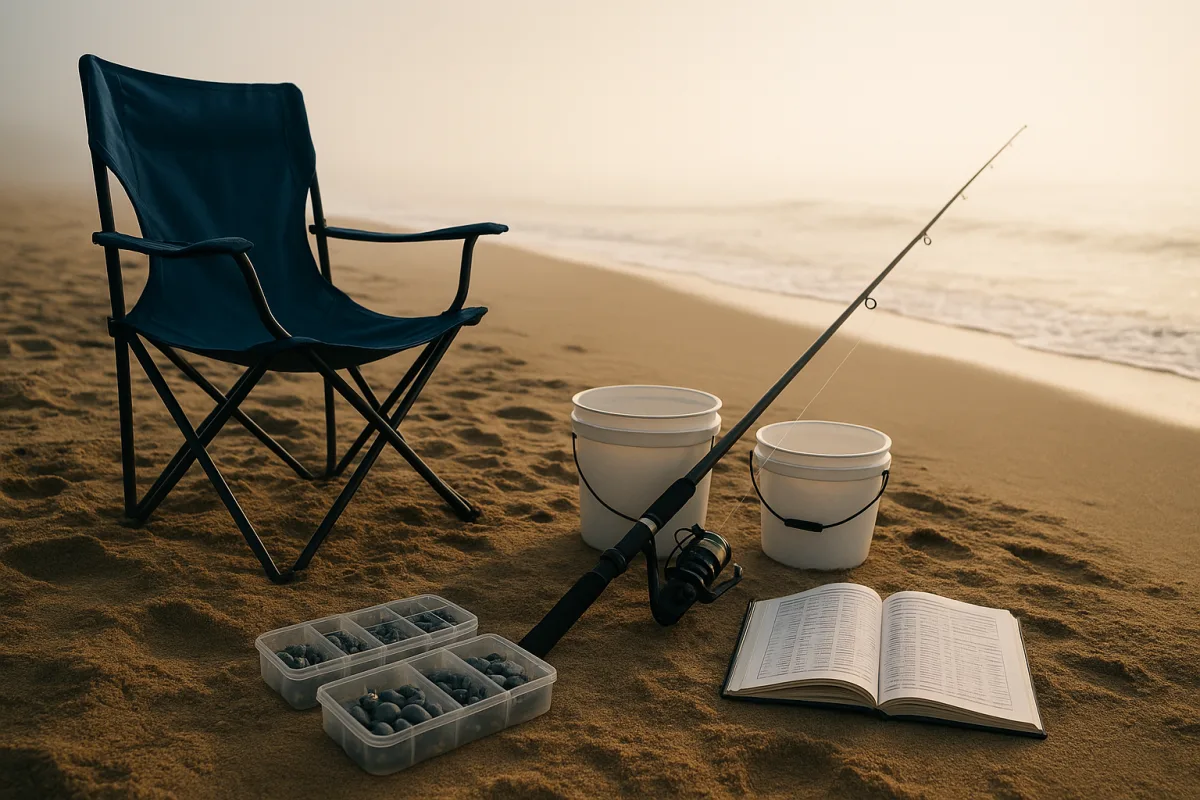
Start with the fish, the coast and the date
A surf trip succeeds or fails before the tackle bag is packed. Start by deciding what might reasonably be present on that beach during your chosen week, then build the bait, rig and timing around that fish.
On North Carolina’s Outer Banks, late-summer flounder anglers commonly use mud minnows or finger mullet, according to Axios and Outer Banks Surf Fishing. Those are targeted choices for fish working the surf or inlet edges, not universal beach bait. [1][9]
Florida changes again during the autumn mullet run. Florida Rambler identifies September through December as a productive period for surf fishing, when migrating mullet can draw larger predators close to beaches. Live mullet makes sense during that event. [10]
On Oregon beaches, the Oregon Department of Fish and Wildlife recommends sand shrimp for surfperch. That is a useful reminder that copying a Gulf Coast pompano setup onto a Pacific perch beach is not preparation. [11]
Write down one primary target and one fallback species. If wind, dirty water or lack of bait makes the primary plan poor, the fallback keeps the trip practical without requiring a second full tackle system.
Check whether the beach is fishable before loading the vehicle
Read the marine forecast, not merely the weather icon. Wind direction, swell height, period, lightning risk and the rip-current forecast determine whether a beach can be safely fished and whether a light rig will hold bottom.
Hurricane season runs from June 1 through November 30, so Atlantic and Gulf trips need particular care during that period. Building swell, onshore wind and fast-moving storms can turn an accessible beach into unsafe water quickly. [6]
Big surf is not automatically good surf fishing. It may create feeding water, but it can also make a bait presentation impossible, bury structure under whitewater and put anglers into hazardous current. If sinkers will not hold and waves are washing gear away, move or postpone.
Check local reports for jellyfish and sharks as well. Florida’s 2026 jellyfish blooms and reports of shark activity along North Carolina beaches are reasons to keep hands, feet and bait management disciplined, particularly at dawn, dusk and in murky water. [6]
A personal flotation device is sensible around jetties, steep cuts and heavy surf, though the research does not establish it as a universal surf-fishing requirement. Wear a wader belt with chest waders, avoid entering moving water unnecessarily and never treat a sandbar as fixed ground. [6]
Set the tide window, then use it to select a beach
Open a local tide chart for the exact beach or nearest reliable station. Surfline’s Seven Presidents tide calendar illustrates the kind of local high and low tide data worth checking, rather than relying on a generalized regional tide time. [5]
New and full moons produce spring tides, with higher highs and lower lows. Quarter moons create neap tides with less range. Neither phase guarantees fish, but the range changes how much beach structure is exposed and how fast water moves through cuts. [6]
For a first visit, arrive around low tide or several hours before the intended fishing window. Low water exposes bars, troughs and drains that can disappear once the tide rises. Mark them mentally, then fish those lanes as water returns.
An incoming tide often gives fish access to the trough behind the first bar, while an outgoing tide can concentrate moving water through a cut. The useful question is not whether “high tide is best,” but where bait will be pushed at this beach during this stage.
Do not force a tide theory onto blank water. A steep, wind-blown beach with no defined trough may fish poorly even at a traditionally productive tide. Conversely, a visible cut with clean water and current may deserve attention outside the fashionable tide window.
Deal with rules and access before investing in the drive
Buy the right fishing licence and check whether the beach permits fishing, night access, driving or parking where you intend to go. Costs matter: New Jersey non-resident licences can cost $35 per week, while Assateague vehicle permits are listed at $25 for seven days. [18]
Confirm species rules for the state, especially size and possession limits. Texas red drum, for example, have a 20 to 28-inch slot limit cited in surf-fishing guidance. Measure fish before deciding whether they enter the cooler. [6]
Seasonal wildlife closures can remove otherwise obvious water from consideration. Piping plover nesting zones may restrict access from March through August, and beach-access rules can differ sharply across California and Florida locations. [6]
This check is not paperwork after the fact. It decides which entrance you use, whether a cart is practical, where you can fish after dark and whether the nearest legal access leaves you within walking distance of the productive structure.
Read the beach before choosing a casting spot
Stand back from the wash line and watch several wave sets. You are looking for uneven breaking waves, darker water, smoother channels and places where foam or current travels seaward. Those clues can reveal bars, troughs and rip currents. [15][16]
A sandbar commonly makes waves stand up and break in a consistent line. The deeper trough inside it may appear darker and calmer. A cut through the bar can show as a darker gap where waves break less aggressively and water drains outward.
Fish use these features because they concentrate movement. Bait can wash along a trough, cross the bar through a cut or gather where current slows at an edge. Put a bait where that traffic is occurring instead of casting blindly over every visible wave.
Rip currents deserve respect, not a cast dropped into their center by default. Their edges can be useful feeding lanes, but the current may also drag a light rig, foul line and create dangerous footing. Fish from dry sand where possible.
The common beginner error is casting over the first bar because distance feels productive. Multiple surf-fishing guides caution that fish may be in the first trough, close enough that an oversized cast puts the bait beyond the better water. [14][15]
Build a rod, reel and line system that fits the water
For general Atlantic and Gulf surf work, a 9 to 12-foot rod, with 10 feet as a common middle ground, is a practical starting category. Medium-heavy to heavy power and moderate-fast action handle bait rigs and surf sinkers. [2][4]
Pacific anglers often fish different water and smaller species. An 8 to 10-foot rod and lighter 15 to 30-pound line can be more appropriate there, rather than treating a 12-foot heavy outfit as mandatory. Oregon surfperch fishing is the clearest regional example. [11]
Pair the general surf rod with a 4000 to 6000-size spinning reel. For larger species, the 5000 to 6000 range offers the line capacity generally recommended for 200 to 300 yards of 20 to 30-pound braid. [3][4]
Braid supplies capacity and casting efficiency, but it should not be tied directly to every hook rig. Add a mono or fluorocarbon leader to provide abrasion resistance near sand, shells, fish teeth and structure. [4][12]
For ordinary conditions, a 20 to 40-pound leader in the rough range of 2 to 4 feet is common guidance. It is not a universal rule, and anglers should resist treating it as one. [2][12]
When targeting striped bass or red drum in heavy shore break, specialized striped-bass guidance moves to 50 to 80-pound leaders, sometimes extending to two or three rod lengths. That heavier, longer approach addresses abrasion and force, but is excessive for every beach. [7]
Rig for holding bottom, not for looking tidy
Carry circle hooks from roughly 1/0 through 7/0. Choose the lower end for smaller baits and species, and reserve larger hooks for substantial baits and larger fish. Circle hooks are a practical default for bait fishing. [4][13]
A fish-finder rig is a common starting system: a sliding sinker connection above a swivel, then a leader and circle hook. It lets a fish take bait with less immediate resistance than a fixed sinker arrangement. [4][16]
Use pyramid sinkers, but pack several weights. General setup guides suggest 2 to 5 ounces, while stronger-surf regional advice goes as high as 4 to 8 ounces. The discrepancy reflects conditions, not necessarily bad information. [4][6]
Start as light as conditions allow. If the sinker walks steadily down-beach or the line bows so badly you cannot detect a bite, add weight. If an 8-ounce pyramid still will not hold, the better decision may be a protected beach or another day.
Bring extra pre-tied leaders, swivels and hooks. Surf fishing eats terminal tackle through abrasion, crossed lines and snagged structure. Re-rigging quickly matters most during a brief moving-tide window, when a missing bait is simply lost fishing time.
Pack for the hours when conditions change
Use a sand spike to keep the rod off abrasive sand and to keep it stable when a fish picks up the bait. A tackle bag, long pliers and a headlamp are core accessories, not optional clutter. [13][14]
The headlamp matters because the best tide window may overlap dawn, dusk or darkness, and because knot-tying with a phone light leaves both hands unavailable. Pack spare batteries and keep a separate light for the walk back.
Budget realistically. General guidance places a basic surf setup around $250 to $500 before bait and permits. That should cover the rod, reel, line, terminal tackle and basic accessories, but not every regional need or travel cost. [14]
A charter can be a costly shortcut to local information. B & D Highlands Fishing Charters lists six-hour trips from $370 or more, which may be useful for learning a specific area but is not required for a prepared shore trip. [17]
Pack water, sunscreen, footwear suited to shell or hot sand, a measuring device and a cooler only if legal harvest is planned. Keep bait cold, separate from food, and bring enough to rebait after crabs, pinfish or surf chop strip it away.
Fish the plan, then change only when the water tells you to
At the beach, make the first cast into the closest identified trough or along the edge of a cut. Use enough weight to hold, keep the line managed and check bait regularly, especially where small scavengers are active.
Give a spot time only while it continues to offer a reason. Moving water, visible bait, a defined trough and a holding sinker are reasons. A featureless flat, slack line dragged by current and repeatedly empty hooks are reasons to move.
If the tide exposes more structure than expected, walk and look rather than immediately recasting. If wind strengthens enough that the sinker will not hold or waves erase the safe working area, stop treating persistence as skill.
The available research does not provide catch-rate data proving one rig, lure or leader formula consistently outperforms another across regions. Preparation therefore means carrying adaptable components, reading the water honestly and refusing to fish a plan that conditions have already disproved.
Frequently Asked Questions
How do I prepare for a surf fishing trip?
Begin by selecting your target species and confirming their presence on the chosen beach during your planned week. Research local bait preferences and tides, then plan your bait, rig, and timing accordingly. Also, check local access rules, licenses, nesting closures, and marine forecasts to ensure the beach is fishable and safe.
What gear should I pack for surf fishing?
Pack a surf rod between 9 and 12 feet (10 feet is common), a spinning reel sized 4000–6000, and braided line rated 20–30 pounds. Bring leaders matching your target species and surf conditions—generally 20–40 pounds, but up to 50–80 pounds for heavy shore breaks or large fish. Include pyramid sinkers ranging from 2 to 8 ounces to suit surf strength, along with circle hooks, sand spikes, tackle bags, and pliers.
How do tides affect surf fishing trips?
Tides influence which beach structures are exposed and how water moves through troughs and cuts. Spring tides during new and full moons cause higher highs and lower lows, revealing more structure, while neap tides have less range. Arriving several hours before your fishing window, ideally near low tide, helps you identify productive spots to fish as the tide rises.
What safety checks should I do before surf fishing?
Check detailed marine forecasts including wind, swell, lightning, and rip current risks, especially during hurricane season (June 1–November 30). Monitor local reports for jellyfish blooms and shark activity. Wear a wader belt with chest waders, avoid entering moving water unnecessarily, and consider a personal flotation device near jetties or heavy surf. Always respect beach closures and protected areas.
How we researched this
This article was assembled from 19 cited references.
Nothing here is based on hands-on testing. Where a figure or finding appears, it belongs to the source cited beside it, and the writing says so rather than implying otherwise. Every source is listed below so you can check it.
Sources
- Flounder fishing returns ahead of Labor Day weekend
- Best Surf Fishing Rods - Fishing Gear Guide | knots.fish
- Ultimate Surf Fishing Combos for 2026 - Reel Gear Guide
- Surf Fishing Setup for Beginners: Rod, Reel, Line & Rig | The Fisherman’s Hub
- Seven Presidents Tides - Updated High & Low Tide Seven Presidents Tide Time Charts - Surfline
- Surf Fishing 2026 — Catch More from Shore | FishingWorldGuide
- What LB Fishing Line Do You Need For Striped Bass? - Center of Outdoor
- Got Pompano? – OBX Surf Fishing
- Flounder Fishing the Outer Banks: Surf & Inlet Guide
- Prime time for surf fishing: Late summer, early fall
- How to fish for surfperch | Oregon Department of Fish & Wildlife
- The Complete Guide to Surf Fishing Setups — Rod & Reel
- Surf Fishing Gear : Tackle / Surf Fishing Gear / Gear Shop | Red Sky Surf Hunters
- Beginner Surf Fishing Setup: What to Buy First Without Wasting Money
- Surf Fishing Guide: How to Catch Fish from the Beach — The Fishing Manual
- Surf Fishing Guide: Rigs, Baits, Best Beaches & Techniques | One…
- Rates & Policies | B & D Highlands, NJ Fishing Charters
- Surf Fishing Trips on Assateague Island | Fish Assateague
- Surf fishing
Related Articles
Best Surf Fishing Setup for Fall: Gear, Rigs & Tides Guide
Discover the best surf fishing setup for fall with gear, rigs, and tips on reading tides and beach structure for successful autumn fishing.
Best Surf Fishing Setup for Summer: Rods, Rigs & Tides
Discover the best surf fishing setup for summer, including rods, rigs, tides, and beach reading tips for successful fishing sessions.
Surf Fishing in Murky Water: Tips for Catching Fish
Learn how to catch fish surf fishing in murky water with rigs, bait, and beach reading tips for low-visibility conditions.
How to Prepare for a Surf Fishing Tournament
Learn how to prepare for a surf fishing tournament with the right gear, rigs, rules, and beach reading strategies to improve your chances.