
Surf Fishing in Murky Water: Tips for Catching Fish
Learn how to catch fish surf fishing in murky water with rigs, bait, and beach reading tips for low-visibility conditions.
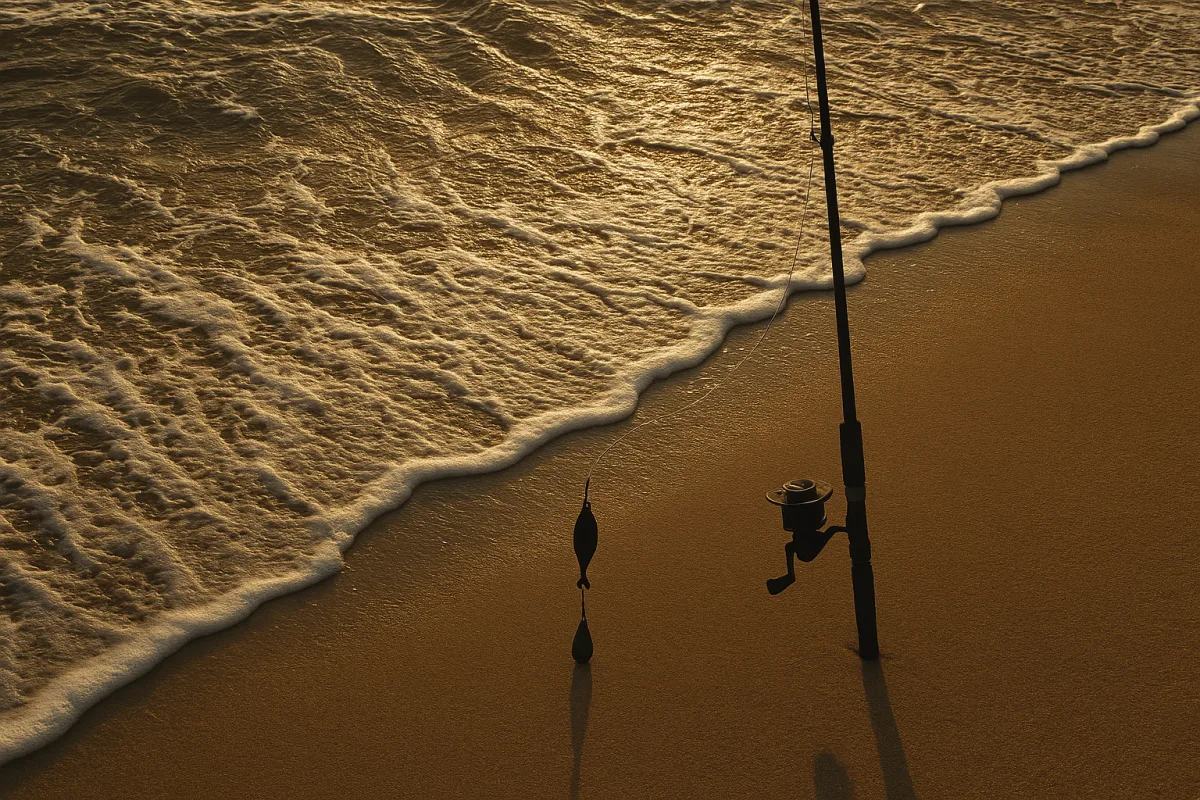
First, decide whether the water is fishable
Murky water is not automatically bad water. A stained surf can put bait and predators close to shore, particularly after wind or swell has disturbed the bottom. The useful question is whether fish can still locate food, not whether you can see your feet.
Turbidity reduces visual range and makes foraging less efficient, so fish must rely more heavily on non-visual senses when suspended sediment blocks the water. Research published in Scientific Reports found high turbidity altered fish movement during a foraging task. [1]
That matters at the beach because a fish in brown water cannot inspect every offering from several yards away. Your bait must enter its short detection range, or create enough vibration, scent or contrast for the fish to home in.
There is a point where dirty water becomes unproductive. Guidance collected by Unanswered.io warns against fishing extremely turbid water, when fish feeding can be minimal. [11] If the surf is a solid, featureless wall of sand-laden foam, wait for it to settle or move to cleaner water.
Do not confuse stirred-up water with structure. A little color around a defined trough, a rip seam or the down-current side of a bar can be worth fishing. Brown water with no current break, no foam pattern and no bait activity gives you little reason to stay.
Find the feeding lane before selecting a lure
Start from high sand and watch several wave sets. You are looking for a darker, smoother lane between whitewater bands, which often indicates deeper water, plus places where waves break unevenly over a bar. Take Me Fishing recommends using rips, foam and debris to identify feeding areas. [7]
A rip is especially useful in murky conditions because it moves water, dislodges food and provides a corridor through the breakers. Fish may sit beside the fastest current rather than directly in it, where they can intercept prey without spending unnecessary energy.
Do not make the standard mistake of casting as far as possible. Fishing Zenith’s murky-water guidance identifies overcasting as a common error because fish may feed closer to shore. [11] In a dirty surf, the first trough can be the only water that needs serious attention.
Make a short cast into the nearest trough before working the outer bar. Then cover the inside edge of a rip, the seam where foam meets darker water, and the sheltered side of a sandbar. Those are controlled searches, not hopeful long casts.
Light onshore wind can improve the close-range opportunity by pushing water and potential food toward the beach. OuterBanks.com notes that light onshore breezes can bring fish closer to shore. [8] A hard blow that makes the water unfishable is different from a manageable breeze.
If you cannot identify a trough or seam, walk before committing to a stand. Murky water removes visual clues beneath the surface, so wave shape becomes your map. A consistent gap in breaking waves is usually more useful than an impressive-looking stretch of whitewater.
Build a rig that stays put and survives the wash
The first rig problem in murky surf is not subtle presentation. It is keeping your bait or lure in the zone long enough for a fish to find it. A rig rolling uncontrolled through the wash is repeatedly leaving the area you intended to fish.
For heavy shore break, Bowery Beach recommends a leader of roughly 3 to 4 feet. [12] That length gives some separation between terminal tackle and main line without creating an excessively long section that is awkward to cast and manage around breaking waves.
Use abrasion resistance as the leader priority around sand, shell and rough surf. Bowery Beach recommends 40-to-60-pound fluorocarbon in this setting, while Northeast Angling suggests 30-to-50-pound fluorocarbon leaders for striped bass and red drum. [12][13]
The sensible overlap is a 40-to-50-pound fluorocarbon leader when abrasion is a concern and the target species fits that range. Go lighter only when conditions are mild enough to justify it. Dirty water does not eliminate the need to keep a rig intact.
For the main line, Northeast Angling recommends pairing 20-to-30-pound braid with a 30-to-50-pound fluorocarbon leader to retain sensitivity while maintaining strength. [13] Braid helps you detect a tap or a change in bottom contact through wind, surf noise and line bow.
Connect braid to leader with an FG knot, then use a Palomar or improved clinch knot for the lure connection, as recommended by Center of Outdoor. [14] Knots are not a glamorous adjustment, but a weak connection wastes the only bite you may get.
Choose enough sinker weight to hold the rig in the selected trough or current seam. The research brief does not provide surf-specific weight recommendations for murky water, so there is no honest universal ounce figure to give. Conditions, current and tackle determine the minimum.
What is clear is that a sinker that is too light is a recurring failure in rough surf. Foragefish advises anglers to avoid tackle that cannot hold bottom, because a drifting presentation reduces control and can cost rigs. [9]
Give fish a target they can detect
When visibility is poor, color alone is not a complete answer. The Environmental Literacy Council recommends bright, contrasting colors such as chartreuse, white and firetiger for dirty water, while black and blue can create a strong silhouette against a lighter murky background. [2]
Academy likewise lists fluorescent chartreuse, white and firetiger, along with black, black-and-blue and dark green, as muddy-water options. [4] Carry both bright and dark choices, because the background can vary from pale sand-stained water to dark runoff.
The practical choice is simple. Start with chartreuse, white or firetiger when you need a bright target in dingy but light-colored water. Start with black, black-and-blue or dark green when a darker silhouette is likely to stand out better.
Do not read that as proof that one color will catch every surf species. No direct surf-fishing studies were found comparing bait colors and types in murky water. These are general angling principles, so local water color and species behavior still require deliberate experimentation.
Vibration and sound deserve as much attention as color. The Environmental Literacy Council recommends vibration-producing and noisy lure types, including Colorado-blade spinnerbaits, rattling crankbaits and buzzbaits, because fish can use their lateral line when visibility is low. [2]
Those examples come largely from general dirty-water angling, not surf-specific trials. In the surf, apply the principle rather than forcing a freshwater lure category into every situation: choose terminal offerings that create detectable movement or sound and can still be worked properly in current.
A larger profile can also help fish locate the offering. FishingHQ advises slower retrieves, increased vibration, larger profiles and fishing close to structure or features when visibility is low. [3] Bigger is useful only if it remains fishable in the surf you have.
Slow down enough for a fish to find it
Murky water changes the retrieve problem. In clear conditions, a fish may spot a fast-moving lure and chase it. In dirty water, the lure can leave the fish’s detection range before the fish has identified its direction.
FishingHQ recommends slowing the retrieve in low visibility. [3] That means working the lure through the trough with enough pace to preserve action, but not burning it across the current seam. Let it remain near the suspected holding water.
Make repeated casts through the same productive lane before moving. Each pass should keep the offering near the bottom contour, foam edge or rip margin you identified. Random fan-casting has a place when searching, but it is not a substitute for working structure carefully.
If you are fishing natural bait, scent becomes a major part of the presentation. The Environmental Literacy Council notes that scent attractants can improve a fish’s ability to detect bait in turbid water. [2] Use bait with scent or add an attractant where permitted.
Avoid scentless, low-vibration offerings when visibility is poor unless they are being fished in a clearly productive lane. Fishing Zenith lists baits lacking scent or vibration among common murky-water mistakes. [11] In this setting, subtlety can become invisibility.
Time the trip around water movement
Check the tide chart before choosing the beach access point. Take Me Fishing advises surf anglers to fish moving tides rather than slack water. [7] Incoming and outgoing water both create current, while slack periods often remove the movement that concentrates forage.
An incoming tide can improve access to the first trough and bring water over productive bars. An outgoing tide can strengthen rips and seams. Neither phase is automatically superior without knowing the beach, but both give you a reason to target current edges.
Dawn and dusk are sound starting windows, and Farmers’ Almanac identifies night as productive for species including striped bass. [6] Low light does not make murky water clear, but it aligns your effort with periods when many surf predators are already comfortable feeding.
Spring and fall are also worth prioritising because seasonal fish activity and migrations can improve surf opportunities, according to Farmers’ Almanac. [6] That does not override local conditions. A good migration window still fails if the surf is too dirty to fish effectively.
When you arrive, match the plan to what the tide is doing. If water is moving through a defined rip and the first trough holds shape, fish it. If the tide has gone slack and the surf has become featureless, move, wait or call it.
Adjust one variable at a time
Murky-water fishing produces fewer visual confirmations, so make changes methodically. Begin with a secure rig, a scent or vibration cue, and one high-contrast color. Fish a promising trough long enough to know whether the presentation is reaching the zone.
If there are no signs of life, change location before changing every piece of tackle. A better rip, a cleaner edge of the plume, or a closer feeding lane is often more valuable than cycling through colors in water with no current or structure.
Then change contrast. Move from chartreuse or white to black-and-blue, or reverse the order, depending on the water’s background. Next adjust retrieve speed or lure profile. That sequence makes it possible to learn what the fish can actually detect.
There is no direct research in the brief showing how regional sediment type or water composition changes rig performance in murky surf. Treat local adaptation as necessary, not optional. Keep notes on tide stage, wind direction, water color, structure and the presentation that drew attention.
Frequently Asked Questions
How do you catch fish when the water is murky while surf fishing?
In murky water, fish rely less on sight and more on other senses like vibration, scent, and contrast. Focus on fishing near current breaks such as rips, troughs, and foam lines where food concentrates. Avoid overcasting; fish often feed closer to shore in the first trough or near structure rather than far beyond the breakers.
What rigs work best for surf fishing in murky water?
Use a 3-to-4-foot abrasion-resistant fluorocarbon leader to withstand rough shore break and protect your rig. Leaders in the 40-to-60-pound test range are recommended for durability, especially around sand and shell. Avoid underweighted sinkers that cause your rig to tumble out of the feeding zone.
How do you read the beach to find fish in murky surf conditions?
Look for darker, smoother lanes between whitewater bands indicating deeper water or troughs. Identify rips and foam seams where currents move food and create feeding corridors. Watch wave sets for consistent gaps in breaking waves, which often mark productive feeding zones closer to shore.
What bait and lures are effective in murky surf water?
Choose baits or lures that provide multiple attractants such as scent, vibration, sound, and strong silhouettes. Bright and contrasting colors like chartreuse, white, fire tiger, black, and blue help fish detect your lure. Lures that produce vibration or noise, like spinnerbaits with Colorado blades or rattling crankbaits, are effective in low-visibility conditions.
When is the best time to surf fish in murky water?
Plan your fishing around moving tides, especially dawn, dusk, and night for species like striped bass. Avoid slack tides and times when the water is so muddy that feeding activity has stopped. Light onshore winds can improve fishing by pushing food and fish closer to shore.
How we researched this
This article was assembled from 15 cited references.
Nothing here is based on hands-on testing. Where a figure or finding appears, it belongs to the source cited beside it, and the writing says so rather than implying otherwise. Every source is listed below so you can check it.
Sources
- High turbidity levels alter coral reef fish movement in a foraging task | Scientific Reports
- What color bait is best for dirty water? - The Environmental Literacy Council
- Turbidity and visibility — FishingHQ
- Lure Colors for Muddy and Clear Water | Academy
- Best Bass Fishing Lures for Muddy Water: 2026 Guide – GreatAdventureSupply
- Catch Striped Bass From Shore: Full Guide
- Surf Fishing - Take Me Fishing
- Surf Fishing Guide - OuterBanks.com
- How To Fish Rough Surf: 5 Steps For Better Catches - Foragefish
- De Surf Fishing: Your Complete Guide - Fishingfactor
- Catch More Fish in Murky Water: Expert Tips & Lures
- How to Set Up a Surf Fishing Rig: Step-by-Step Guide
- Striped Bass Surf Fishing Tackle & Techniques
- What LB Fishing Line Do You Need For Striped Bass? - Center of Outdoor
- The effect of water clarity on fishing - The Fishing Website
Related Articles
Best Surf Fishing Setup for Fall: Gear, Rigs & Tides Guide
Discover the best surf fishing setup for fall with gear, rigs, and tips on reading tides and beach structure for successful autumn fishing.
How to Fish During Low Tide
Learn how to fish during low tide with tips on finding fishable water, choosing rigs, casting distance, and reading the beach for surf fishing success.
How to Find Fish in the Surf: Reading the Beach & Tides
Learn how to find fish in the surf by reading tides, water features, and beach structure for better surf fishing success.
Best Surf Fishing Setup for Summer: Rods, Rigs & Tides
Discover the best surf fishing setup for summer, including rods, rigs, tides, and beach reading tips for successful fishing sessions.