
How to Set Up a Surf Fishing Rig: Step-by-Step Guide
Learn how to set up a surf fishing rig with the right line, sinker, leader, and knots for effective surf fishing in various conditions.
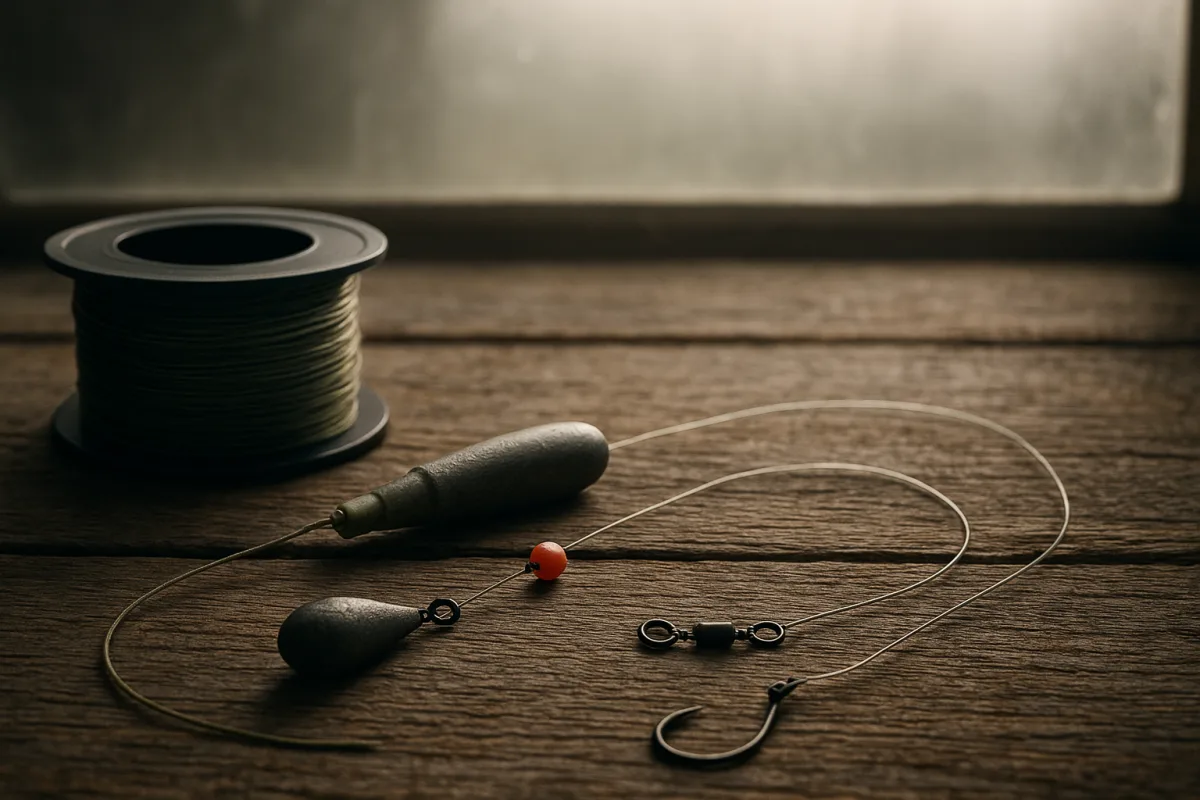
Start with the water you are actually fishing
A surf rig is not a fixed recipe. Before tying anything, check the wind, swell, tide movement and current. The sinker has one job: keep bait where fish can find it. If it rolls, drags or repeatedly washes ashore, the rig is underweighted.
For a general bait rig, the Port Aransas guide from Beached Inn specifies 20 to 30 pound braided main line, a 2 to 6 ounce pyramid sinker, a barrel swivel, a 24 to 36 inch leader and a 1/0 to 4/0 circle hook. [1] That is a practical starting range, not a universal surf prescription.
Hatteras Island tackle guidance breaks sinker choice down by conditions: 2 to 3 ounces for light surf, 3 to 4 ounces for normal conditions, 4 to 5 ounces in moderate current, 5 to 6 ounces in strong current, and 6 to 8 ounces in very strong current. [3]
Those weights come from Hatteras conditions, so treat them as a working scale rather than law. A 3-ounce pyramid that holds in a protected trough may be useless beside an inlet on a running tide. Conversely, an 8-ounce anchor is needless in shallow, gentle water.
Choose a pyramid sinker when you need a conventional surf weight that digs into sand. For very hard-running tidal water, Sputnik sinkers in the 6 to 8 ounce range or heavier provide more holding power through their wire legs. [3]
An egg sinker has a different role. Surf Fishing Sinkers recommends roughly 3/4-ounce egg sinkers for light current and shallow structure, where a bait should move more naturally rather than be pinned down by a heavy anchor. [4]
Put the main line and shock leader together first
Spool the reel with braid before building the terminal rig. Beached Inn recommends a 6000 to 8000 size reel with 30 to 65 pound braid for a 9 to 11 foot surf rod, plus a 25 to 30 foot mono shock leader. [1]
The shock leader is not the same as the leader beside the hook. It absorbs casting force and gives the sinker something tougher to pull against. FishingKnots.com puts a typical mono shock leader at 40 to 80 pounds and around one-and-a-half rod lengths. [5]
That creates a useful difference in published setups. A 12-foot rod might use an 18-foot shock leader under the one-and-a-half-times rule, while Beached Inn suggests 25 to 30 feet. [1][5] Either way, do not use a short, light leader that leaves braid taking the casting shock.
For joining braid to a shock leader, FishingKnots.com lists the FG knot and Alberto knot as suitable choices. The FG is regarded as the stronger connection, but the Alberto is easier to tie, which matters if you cannot tie an FG consistently in wind and low light. [5]
Tie the connection at home until it is repeatable. Wet every knot before drawing it tight. FishingKnots.com identifies failure to wet knots as a common cause of weakened connections, a small error that becomes expensive when a heavy sinker is involved. [5]
Build the basic sliding-sinker rig in order
Once the shock leader is attached, thread a sinker slide onto the shock leader. This is the moving clip or sleeve that carries the pyramid sinker while allowing the fish to take bait without immediately pulling against the full sinker weight. [1][11]
After the slide, add a bead. Then tie on a barrel swivel. The bead sits between slide and swivel, reducing the chance that the hard slide repeatedly strikes the swivel knot under wave action and casting pressure. [1]
Use an improved clinch knot or uni knot to secure the swivel if those are knots you can tie cleanly. Beached Inn includes both in its basic rig guidance, while FishingKnots.com recommends a Palomar knot for lighter terminal tackle. [1][5]
Now tie a 24 to 36 inch leader to the open eye of the barrel swivel. Fluorocarbon or monofilament in the 20 to 40 pound range is the general specification in the Beached Inn rig. [1] Keep it simple until conditions demand otherwise.
The leader is deliberately lighter and shorter than the shock leader in this standard arrangement. It is the replaceable section nearest the fish, bait, shell bottom and abrasion. If it becomes nicked, curled or frayed, replace it rather than adding another swivel.
Finish with a circle hook in the 1/0 to 4/0 range. [1] Choose within that range according to bait size and target, rather than treating the largest hook as automatically stronger. Oversized hooks can leave smaller baits poorly presented.
For heavy hook leaders, FishingKnots.com recommends the San Diego Jam knot. A Snell is another knot listed in the Beached Inn setup, particularly appropriate when using a circle hook. [1][5] Pick one connection and learn to inspect it carefully.
Change the leader before blaming the hook
The standard 24 to 36 inch leader is not enough for every shore break. For striped bass in heavier surf, published guidance commonly uses a 3.5 to 4 foot leader in 40 to 60 pound test. [2] That is a meaningful increase in abrasion resistance.
Other striped-bass guidance puts fluorocarbon leaders at 30 to 50 pounds, so there is no single settled number. [2] Use the lower end only where the water and bottom allow it. In hard shore break or rough structure, heavier leader is the defensible choice.
Do not confuse stronger leader with a cure for poor presentation. A long leader that wraps around the sinker slide, or a bait bundle that spins during every cast, catches less effectively than a straightforward rig that lands cleanly and remains on the bottom.
If your casts keep breaking off, first inspect the shock leader, leader knot and sinker weight. The Magazine and Bowery Beach both identify light shock leaders, poor knot practice and mismatched sinkers as recurring beginner errors. [9][10]
Match the rig to the coast and target
East Coast surf fishing commonly leans toward 10 to 12 foot rods and fish-finder-style sliding-sinker rigs. These are often used for striped bass and bluefish with cut bunker, mullet or mackerel. [6][7]
That setup makes sense where current, distance and larger bait matter. The moving sinker lets a fish pick up bait with less immediate resistance, while the heavier casting system manages the sinker needed to hold in the wash.
West Coast surfperch fishing is a different proposition. Rod & Reel and West Marine describe shorter 8 to 10 foot rods, Carolina-style rigs with egg sinkers, and baits such as sand crabs, worms and shrimp. [6][7]
A heavy pyramid and a large strip of cut bait may be reasonable on an East Coast beach with a running tide. It is not automatically the right answer for surfperch feeding in shallower water, where the lighter egg-sinker approach is intended to move with the conditions. [4][6]
The useful question is not, “What is the best surf rig?” It is, “What needs to hold here, what bait is available, and where are the fish feeding on this tide?” A rig that cannot stay in position cannot present bait.
Load bait without turning it into a tangle
Use enough bait to cover the hook point properly and survive the cast, but not so much that it spins like a propeller. Overloading bait is a documented beginner mistake because it causes tangles and reduces the clean presentation a sliding rig is meant to provide. [9][10]
Circle hooks require restraint. Keep the hook point exposed and do not bury it in a thick wad of bait. When the rig is assembled, pull the leader straight, hold the sinker slide above the swivel, and check that nothing can loop around the hook.
Before every cast, inspect the line from rod tip to sinker. A wind knot in braid, a chipped swivel eye, a flattened leader knot or a cracked sinker slide can end the cast. These checks take seconds and prevent avoidable tackle loss.
Beached Inn advises casting beyond breaking waves with a 9 to 11 foot rod. [1] That can be useful where fish are holding outside the whitewater, but do not make distance the only objective. Moving water around bars, cuts, inlets and river mouths is the better reason to reposition. [13][14]
Adjust timing before rebuilding the whole rig
In summer, The Fisherman recommends concentrating effort in cooler periods: early morning, late evening and after dark. It also points anglers toward moving water around inlets and river mouths, rather than expecting the hottest, quietest part of the day to produce. [13]
Summer guidance also favors larger, flashier bait such as minnows and longer 12 to 15 foot rods in some situations. [13][14] That does not mean every summer session requires a new rig. Start by changing timing, location and bait before multiplying terminal components.
Winter calls for a different read of the tide. Hill Country Post recommends fishing rising water near structure such as jetties and sandbars, while FishingWorldGuide emphasizes presenting minnows with minimal action near warmer pockets. [14][15]
The basic sliding rig still works in those conditions if the sinker holds and the bait stays natural. What will not produce reliably is casting into featureless, slack water simply because the rig is correctly tied. Assembly matters, but placement and tide decide whether that bait is seen.
Frequently Asked Questions
What are the essential components of a surf fishing rig?
A basic sliding-sinker surf fishing rig includes 20 to 30 pound braided main line, a shock leader (typically 40 to 80 pound mono), a sinker slide, a bead, a barrel swivel, a 24 to 36 inch leader, and a circle hook sized 1/0 to 4/0. This setup covers most bait-fishing situations and is a practical starting point.
How do I choose the right sinker weight for surf fishing?
Choose sinker weight based on water conditions rather than just tackle box availability. For light surf, 2 to 3 ounces is typical; moderate currents require 4 to 5 ounces; strong currents need 5 to 6 ounces; and very strong currents may require 6 to 8 ounces or heavier Sputnik sinkers. Pyramid sinkers work well in most sand conditions, while Sputnik sinkers hold better in hard-running tidal water.
What is the proper way to connect braid to a shock leader?
The FG knot and Alberto knot are recommended for connecting braid to a shock leader. The FG knot is stronger but harder to tie consistently, while the Alberto knot is easier to tie in challenging conditions. Always wet knots before tightening to maintain their strength.
How long should the leader and shock leader be for surf fishing?
The shock leader is typically about one-and-a-half times the rod length, often 25 to 30 feet for a 9 to 11 foot rod. The fishing leader (between swivel and hook) is usually 24 to 36 inches long. The shock leader should be heavier than the fishing leader to absorb casting shock effectively.
What knots are best for assembling a surf fishing rig?
For braid-to-shock leader connections, use the FG or Alberto knots. For attaching hooks to heavy leaders, the San Diego Jam knot is suitable; the Palomar knot works well for lighter terminal tackle. The Bimini Twist is used to double the mainline to the shock leader. Always wet knots before tightening to avoid weakening them.
How we researched this
This article was assembled from 15 cited references.
Nothing here is based on hands-on testing. Where a figure or finding appears, it belongs to the source cited beside it, and the writing says so rather than implying otherwise. Every source is listed below so you can check it.
Sources
- Surf Fishing Port Aransas: Rigs, Bait & Best Beaches (2026…
- How To Catch Striped Bass: Complete Guide To Techniques, Gear, And Locations | Fishing Reports Today
- Surf Fishing Sinkers Explained: What Type and Size Should You Use on Hatteras Island? - Frank & Fran's Bait and Tackle
- Egg Fishing Sinkers for Surf Fishing: Rigs, Sizes – When to Use Them - SURF FISHING SINKERS
- Best Knots for Surf Fishing | FishingKnots.com
- The Complete Guide to Surf Fishing Setups — Rod & Reel
- Surf, Jetty & Kayak Fishing Guide: Gear, Techniques & Tips | West Marine
- Surf Fishing Gear : Tackle / Surf Fishing Gear / Gear Shop | Red Sky Surf Hunters
- How to Set Up a Surf Fishing Rig Step by Step - The Magazine
- Common Surf Fishing Mistakes and How to Avoid Them
- Surf Fishing Rigs for Beginners: When to Use Fish-Finder and High-Low Rigs
- How To Make Your Own Surf Rigs: A Complete Guide - Fishingfactor
- Surf: Doldrum Adjustments - The Fisherman
- Surf Fishing 2026 — Catch More from Shore | FishingWorldGuide
- Try These Tips For Winter Surf Fishing - Hill Country Post
Related Articles
Best Surf Fishing Setup for Winter: Rigs, Gear & Tips
Discover the best surf fishing setup for winter including rigs, sinker weights, rod choices, and tips to keep bait in feeding lanes during cold months.
Surf Fishing Knots: How to Tie Strong Knots for Surf Fishing
Learn how to tie essential surf fishing knots like Palomar and FG for strong, reliable connections in surf fishing setups.
Best Surf Fishing Setup for Night Fishing: Rods, Rigs & Gear
Learn the best surf fishing setup for night fishing including rods, rigs, line, and tips for effective bait placement and tide timing.
Best Surf Fishing Setup for Summer: Rods, Rigs & Tides
Discover the best surf fishing setup for summer, including rods, rigs, tides, and beach reading tips for successful fishing sessions.