Surf Fishing Knots: How to Tie Strong Knots for Surf Fishing
Learn how to tie essential surf fishing knots like Palomar and FG for strong, reliable connections in surf fishing setups.
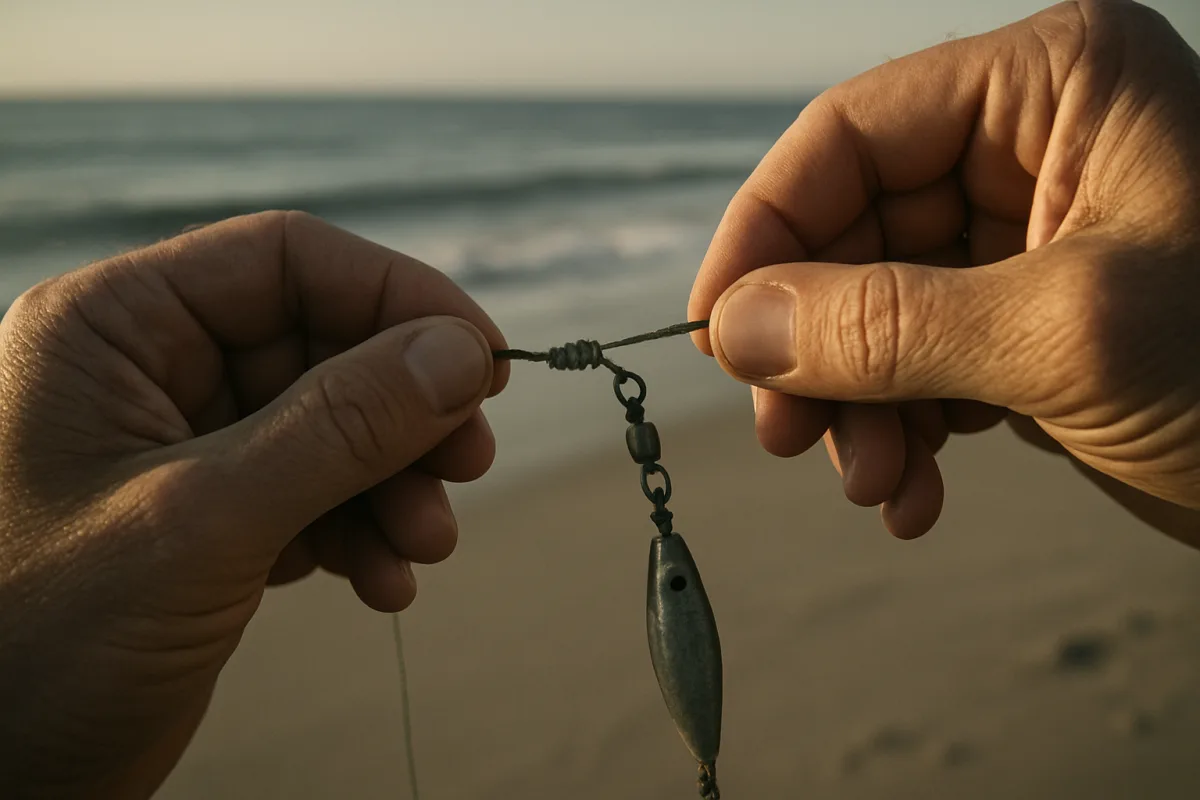
Start with the line you are actually fishing
A surf knot is not just a way to attach hardware. It is the weakest point between a fish and the spool, and surf fishing puts that point under pressure from current, sand, wave surge, rocks, and repeated long casts.
The first decision is line type. Braided main line, monofilament shock leaders, fluorocarbon bite leaders, and wire all behave differently when compressed. A knot that stays put in soft mono may creep under pressure when tied in slick braid. [9][11]
For braided line, begin with the Palomar knot for terminal tackle. It is widely recommended for hooks, swivels, clips, and lures because it is simple to inspect and retains approximately 95 to 100 percent of rated strength in comparative knot databases. [1][10]
For monofilament or fluorocarbon, the Improved Clinch remains a sensible basic knot. It is compact, quick enough to retie after abrasion, and commonly retains about 85 to 90 percent strength in mono and 80 to 85 percent in fluorocarbon. [10]
Do not assume the Improved Clinch is universal. On braid, reported retention drops to roughly 70 to 80 percent, largely because the slick material can slip or fail to seat consistently. A Palomar or properly tied Uni knot is the safer starting point. [9][10]
Before the tide starts moving, rig enough leaders that knot tying is not rushed on a dark beach. There is no supported figure for how quickly an experienced angler should tie knots, but speed is less useful than a clean knot. [11]
Connect braid to your leader before you need a cast
Most surf anglers fishing braid need a leader connection. The leader supplies abrasion resistance around shell, rock, jetty edges, and a fish’s mouth, while the braid supplies casting distance and sensitivity. The FG knot is the standard slim connection. [1][3]
Use the FG knot when a long fluorocarbon leader must travel through rod guides. Its wrapped construction grips fluorocarbon without creating the bulky profile of many doubled-line knots, and knot-strength references commonly place it around 95 to 100 percent retention. [10]
Start the FG by holding the fluorocarbon leader under steady tension. Wrap the braid alternately over and under the leader, building tight, closely packed coils. The wraps must bite into the leader evenly rather than stacking on one side. [1][3]
After making the wraps, lock them with half-hitches around both braid and leader. Then add finishing half-hitches around the braid alone. Pull gradually as the knot beds down, rather than snapping it tight in one hard pull. [1][3]
Trim the fluorocarbon tag close only after checking that the wraps have tightened uniformly. A badly seated FG often looks uneven, with loose braid coils or a leader tag that pulls through when tension is applied.
Striped bass leaders are commonly 2 to 4 feet long in ordinary conditions. In heavy surf or rockier water, guidance extends that range to 3 to 6 feet, with 40 to 60 pound leader material used where abrasion matters more than subtle presentation. [6]
Clearer water and open sand can justify 20 to 25 pound leader for striped bass. That is not a default for a boulder field or a hard-cut trough, where the line can touch structure every time a fish changes direction. [6]
For bluefish, treat teeth as the main problem. Guidance calls for at least a 3-foot fluorocarbon leader or a 4-to-6-inch wire bite leader, with 40 to 60 pound material suggested for the heavier shock and bite section. [7]
An FG knot connects braid to fluorocarbon, but it does not solve a bluefish bite-off. Where bluefish are cutting leaders, add the wire bite section and use the appropriate terminal connection for the wire and lure hardware. [7]
Tie the terminal knot to suit the lure or rig
Once the leader is attached, the next knot usually connects a swivel, clip, lure, jig head, hook, or sinker rig. This is where the Palomar knot earns its place as the first knot worth learning. [1][8]
To tie a Palomar, double several inches of line and pass the loop through the eye. Tie a loose overhand knot with the doubled line, then pass the loop over the hook, lure, or swivel before tightening. [1][3]
Wet the knot, pull the standing line and tag end together until the coils seat, then pull firmly on the standing line. The finished Palomar should sit neatly at the eye with two parallel strands, not crossed or pinched. [3][11]
The Palomar works especially well with braid because its doubled construction gives the knot more material to grip. It also suits mono and fluorocarbon, making it a useful choice when leaders change through the season. [9][10]
Use the Improved Clinch when tying mono or fluorocarbon to a small hook, lure, or swivel and when a compact knot is useful. It is a reasonable beach knot for light leader work, but not the preferred answer for braid. [9][10]
Pass the line through the eye, make five to seven wraps around the standing line, then pass the tag through the small loop nearest the eye. For the improved version, pass the tag back through the larger loop formed behind it. [2][3]
Moisten the wraps before tightening. Draw the knot down steadily while keeping the coils in sequence. If the wraps overlap, start again, because crossed coils create pressure points that can damage fluorocarbon or weaken mono. [11]
Use the Uni knot when the rig changes
The Uni knot is useful when the beach demands flexibility. It can connect terminal tackle, make loops, and join two lines in a double-Uni arrangement, which gives it a practical role in a surf bag with limited tools. [2][5]
For a terminal Uni, pass the line through the eye and lay the tag alongside the standing line to form a loop. Wrap the tag through that loop five or six times, then pull the tag to close the coils. [2][3]
Once the coils are snug, slide the knot toward the hook or swivel eye using the standing line. Wet the knot first, then tighten gradually. The coils should form a compact barrel rather than a loose spiral extending up the leader. [3][11]
A double Uni joins two lines by tying a Uni around the opposite line from each side, then drawing the two knots together. It is bulkier than an FG knot, so it is less attractive when the connection must pass repeatedly through guides. [2][5]
That does not make the double Uni useless. It is a sensible backup connection when joining lines at the beach, particularly if an FG knot has been damaged and conditions are too rough for careful wrap work.
Snell bait hooks when hook alignment matters
The Snell knot belongs on bait rigs where the hook needs to pull in line with the leader. It is commonly recommended for bait fishing because the leader exits along the hook shank instead of from the eye at an angle. [1][4]
Pass the leader through the hook eye from the point side, leaving a tag long enough to run along the shank. Form a loop beside the shank, then wrap the tag around both shank and leader several times. [1][3]
Hold the wraps in place while pulling the standing line until they tighten. The coils should sit evenly down the shank, and the leader should exit through the eye on the point side as intended. [3][4]
A poorly tied snell can rotate, bunch, or leave coils loose near the eye. That matters most when fishing bait in moving water, where a rig is dragged and lifted repeatedly by surf rather than sitting motionless. [4]
Avoid the failures that show up after the fish hits
Most knot failures are not mysterious. The usual causes are selecting the wrong knot for the line, failing to lubricate it, pulling it tight too abruptly, trimming tags too short, or leaving crossed wraps in place. [11]
Wetting matters because friction creates heat as the coils cinch down. Fluorocarbon is especially vulnerable to heat damage during tightening, so saliva or clean water should be applied before the final pull. [11]
Leave at least 1/8 inch of tag end. Cutting closer may look tidy, but it gives no margin if a knot compresses under load. A short tag is especially risky with braid, which can settle after the first hard pull. [11]
Do not overtighten by jerking the line until it deforms. Tighten in stages, inspect the coils, then load the connection steadily by hand. The aim is a seated knot, not flattened or visibly stressed line. [11]
After landing a fish or dragging a rig through rock, run fingers over the leader and knot. If fluorocarbon feels rough, cloudy, nicked, or flattened near the connection, cut back and retie before the next cast.
Carry tools that solve real beach problems
A knot tool is useful when fingers are cold, hooks are small, or eyesight is fading, but it does not replace knowing the knot. The TYEPRO Fishing Knot Tying Tool combines a knot-tying aid with a corrosion-resistant cutter. [14][15]
The TYEPRO tool suits anglers tying clinch or Palomar-style terminal knots with small lures, hooks, and swivels. The research brief does not provide a reliable current price, so it would be misleading to quote one. [14][15]
The HOOK-EZE Fishing Gear Knot Tying Tool is aimed at protecting fingers and helping anglers who have shaky hands or difficulty holding hooks steady. It is most relevant for hook work, not for tying a long braid-to-leader FG connection. [16]
The supplied research identifies these tools but provides no verified price for the HOOK-EZE tool. Treat listings as variable retailer pricing rather than a fixed cost, especially where imported tackle is involved. [16]
Reel lubrication is separate from knot strength, but a rough drag can make any connection fail sooner under surge. Shimano Bantam Oil is described as a thin, dust-resistant reel oil suited to light lubrication points. [17]
Cal’s Universal Star Drag Grease is intended for smooth drag performance, while Super Lube Synthetic Grease is recommended in the research as a saltwater-resistant option for reel gears. Neither lubricant belongs on the fishing line or knot itself. [17][18]
No supported prices are supplied for Shimano Bantam Oil, Cal’s Universal Star Drag Grease, or Super Lube Synthetic Grease. Buy by the maintenance job required, not because a lubricant is presented as a cure for poor knot tying. [17][18]
A sound surf setup is simple: braid joined to an appropriate leader with an FG knot, then a Palomar, Uni, Improved Clinch, or Snell selected for the line and terminal job. Check it before the current turns, not after the rod folds.
Frequently Asked Questions
What are the best knots for surf fishing?
The Palomar knot is recommended for braid-to-hook, lure, or swivel connections because it retains about 95 to 100 percent of line strength. The Improved Clinch knot is suitable for monofilament and fluorocarbon lines but not for braid due to slippage. For connecting braid to a fluorocarbon leader, the FG knot is preferred for its slim profile and high strength retention.
How do you tie a Palomar knot for surf fishing?
While the article does not provide step-by-step tying instructions, it notes the Palomar knot is simple to inspect and widely used for braid connections to terminal tackle like hooks and swivels. It retains nearly full line strength and is a reliable choice for surf fishing when tied properly.
Which knot should I use to connect braid to a fluorocarbon leader?
The FG knot is the standard for connecting braid to a fluorocarbon leader in surf fishing. It involves tightly wrapping the braid around the fluorocarbon leader under steady tension, locking the wraps with half-hitches, and finishing with additional half-hitches around the braid. This knot maintains about 95 to 100 percent of line strength and has a slim profile that passes easily through rod guides.
How do I tie an FG knot for surf fishing?
To tie an FG knot, hold the fluorocarbon leader under steady tension and wrap the braid alternately over and under the leader, creating tight, evenly spaced coils. Lock the wraps with half-hitches around both lines, then add finishing half-hitches around the braid alone. Pull the knot gradually to bed it down, and trim the tag end only after ensuring the wraps are tight and uniform.
What knot retains the most strength for surf fishing lines?
Both the Palomar knot and the FG knot retain approximately 95 to 100 percent of the line’s rated strength, making them the strongest options for surf fishing. The Palomar is best for braid-to-terminal tackle connections, while the FG knot excels at joining braid to fluorocarbon leaders. The Improved Clinch knot retains less strength, especially on braid, where it can drop to 70 to 80 percent.
How we researched this
This article was assembled from 19 cited references.
Nothing here is based on hands-on testing. Where a figure or finding appears, it belongs to the source cited beside it, and the writing says so rather than implying otherwise. Every source is listed below so you can check it.
Sources
- 5 Essential Fishing Knots Every Angler Must Know (With Step-by-Step Instructions) | HookCast
- Fishing Knot Guide | Tackle Box Guide
- Fishing Knots: Step-by-Step Tying Guides with Diagrams
- Knots - Sea Fishing Guide
- Best Fishing Knots Every Angler Should Know | AnglerFinder Blog
- What LB Fishing Line Do You Need For Striped Bass? - Center of Outdoor
- How to Catch Bluefish Surf Fishing
- Essential Fishing Knots Every Angler Should Know | National Fishing Authority
- Braid vs Mono vs Fluorocarbon - Fishing Knot Guide | knots.fish
- Fishing Knot Strength Database | FishingKnots.com
- Why knots slip or break — FishingHQ
- Fishing Knots Guide — 15 Essential Knots Every Angler Must Know
- Seasonal Surf Fishing Strategies: A Year-Round Guide
- Tyepro Fishing Line Knot-tying Tool Clinch Palomar Lure Tackle Hooks Cutter for sale online | eBay
- Best Fishing Knot Tying Tools – A Knot Needed
- HOOK-EZE baliq ovlash Tugmachalarini bog'lash Oʻzbekiston | Ubuy
- 7 Best Surf Fishing Reel Lubricants For Smooth Operation - Swimmer Living
- Cal's Grease – Accurate Fishing
- Essential Fishing Knots Every Angler Should Know — The Fishing Manual
Related Articles
Best Surf Fishing Reels for Beginners
Compare the best surf fishing reels for beginners, including Penn Battle IV 6000 and Pursuit V 5000, to find the right reel for your beach fishing needs.
Best Surf Fishing Setup for Night Fishing: Rods, Rigs & Gear
Learn the best surf fishing setup for night fishing including rods, rigs, line, and tips for effective bait placement and tide timing.
How to Find Fish in the Surf: Reading the Beach & Tides
Learn how to find fish in the surf by reading tides, water features, and beach structure for better surf fishing success.
How to Catch Fish During a Beach Bonfire: Tips and Safety
Learn how to catch fish during a beach bonfire with tips on tides, gear setup, safety, and legal regulations for a successful surf fishing night.