Dealing with Seaweed While Surf Fishing: Rigs and Tips
Learn how to deal with seaweed while surf fishing using the right rigs, gear, and timing to improve your catch and reduce tangles.
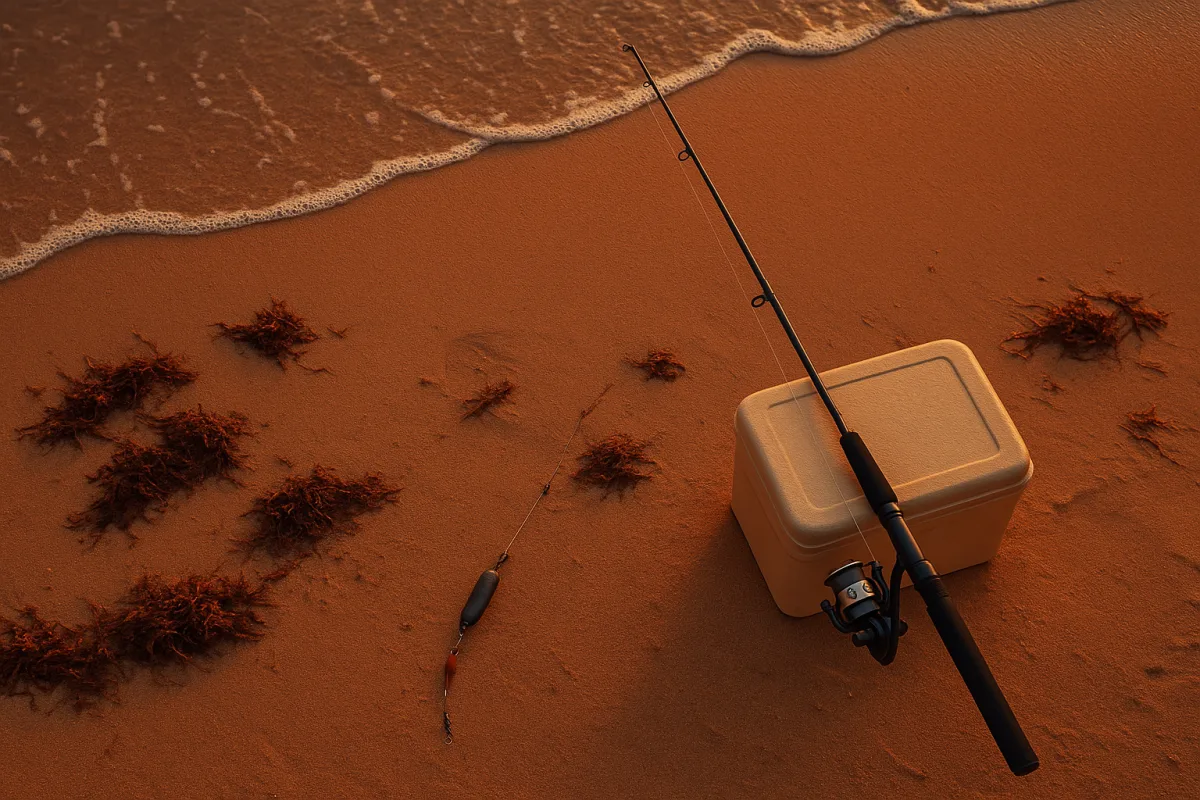
Seaweed in the Surf: Make the Rig Work Before You Cast
The useful idea: separate the anchor from the bait
Seaweed management is not mainly about finding a magical weed-proof lure. It is about controlling where your sinker, bait, and main line sit in moving water. The Fish Finder rig is useful because it creates separation.
The basic setup is straightforward: 20 to 30 lb braided main line, a sliding egg or pyramid sinker of 2 to 6 oz, a 24 to 36 inch fluorocarbon leader in 20 to 40 lb test, and a 1/0 to 3/0 circle hook. [1][2]
The sinker is the anchor. Its job is to reach the bottom and stay there long enough for the bait to remain in a feeding lane rather than skating down-current. The leader is the working section, carrying the hook and bait behind that anchored point.
Because the sinker slides on the main line, the rig is less of a rigid chain than a fixed sinker arrangement. A fish can move with the bait before feeling the full resistance of the lead, which is the original purpose of the design.
For seaweed, the practical advantage is less dramatic but still useful. The weight stays low, while the leader gives the bait room to move independently above or behind it. That reduces the number of points where a bait, weight, and drifting strand can bind together.
It does not mean the bait is floating above all weed. A 24 to 36 inch leader is short by surf-fishing standards because it needs to remain controlled in waves and current. If loose weed is rolling across the bottom, that leader still sits in its path.
That distinction matters. The Fish Finder rig manages scattered weed and occasional clumps. It does not solve a beach where a current is carrying a steady green or brown belt through every trough. In those conditions, fishing longer only produces fouled gear.
Why the sliding sinker helps, and where it does not
A fixed sinker rig makes the hooklength, main line, and weight act as one unit. When weed catches the rig, the whole arrangement can be pulled sideways, rolled, or pinned into the sand by the pressure of current and surf.
A sliding sinker lets the main line move through the weighted section. In theory, this leaves fewer hard tension points between the rod tip and bait. It is a small mechanical advantage, not a guarantee against tangles.
The sinker choice determines whether that advantage is usable. Knots.fish recommends egg or pyramid sinkers from 2 to 6 oz, with the right weight determined by surf conditions. [1] Start with enough lead to hold, not enough to flatten the entire rig.
An egg sinker is streamlined and can be sensible where the bottom is clean and the sweep is moderate. A pyramid sinker gives more purchase in sand, which can matter when an incoming tide begins pushing water along the beach.
Too little weight is often misread as a seaweed problem. If the sinker will not hold, the rig drifts through several zones, gathers weed, and returns looking like the line caused the problem. The real fault is that the anchor failed.
Too much weight creates a different problem. A heavy sinker can bury in soft sand, snag debris, or make every retrieve unnecessarily laborious. Use the lowest weight that holds in the water immediately in front of the productive structure.
There is no published figure showing that one sinker profile reduces weed fouling by a certain percentage. The usual advice toward heavier, streamlined lures and baits is expert consensus and accumulated angler observation, not controlled research. [4]
Build the rig around the water you have
Braided main line is useful in this system because 20 to 30 lb braid provides manageable diameter and direct contact with the rig. Dagon Fishing lists that range for surf fishing, while Knots.fish uses the same range in its rigging guidance. [1][2]
The leader should be treated as a replaceable abrasion section. Knots.fish specifies 20 to 40 lb fluorocarbon at 24 to 36 inches for this rig. [1] In weed and shell-strewn wash, the heavier end makes sense when abrasion is the concern.
A 1/0 to 3/0 circle hook is the stated range for the setup. [1] That gives enough hook for compact natural bait without turning the bait into a bulky, weed-catching package. Match the hook to bait size, not simply to the largest fish hoped for.
Keep the bait compact. Sand fleas and fresh shrimp are standard natural surf baits recommended by Outer Banks Surf Fishing and Aquamarine Power. [3] A neatly secured bait presents less loose material for weed to grab than a long, ragged strip.
There is no rigorous comparison proving that sand fleas foul less often than shrimp, or that one bait style beats another under every seaweed condition. The sensible case is physical rather than statistical: smaller, cleaner bait offers fewer loose edges.
For artificial fishing, metal spoons and bucktail jigs are commonly recommended surf options. [3][4] Their streamlined shapes and relatively quick sink rates can reduce time spent drifting through surface weed, although that benefit has not been quantified.
Do not read “heavier” as “always better.” A spoon or jig that sinks too fast may plough into the bottom weed where a lighter presentation would pass above it. The correct retrieve depth is determined by the weed lane, not tackle fashion.
The tide decides whether the rig gets a fair chance
The Fish Finder rig works best when there is a defined feeding lane and only intermittent weed. Before rigging, look at the water for five minutes. Note whether weed is stranded on the sand, drifting in pulses, or moving continuously across the break.
An incoming tide and the two hours before and after high tide are commonly identified as productive surf periods that can reduce seaweed accumulation compared with less favorable periods. [8] That is a planning advantage, not a promise of clean water.
The useful question is whether the tide is bringing fish into accessible water without carrying a weed line directly through the same zone. A rising tide can flood troughs and cuts where bait and fish travel, making short casts more valuable.
Slack tide is a poor time to assume the beach will clean itself. Take Me Fishing advises anglers to consider tide and conditions in surf fishing, while Foragefish specifically warns that ignoring tide, wind, and weed leads to poor results. [9][17]
Wind matters because it builds the surface transport that pushes floating weed into a fishable gutter or piles it along the shoreline. American Sea Fishing advises avoiding high-wind conditions when kelp and heavy surf complicate California beach fishing. [10]
Fish early if the forecast allows. The Emerald Coast Guide and AZKNS Fishing both identify the first two hours after sunrise and the period before sunset as productive surf windows. [6][7] Low light helps fishing, but it does not overcome a weed-choked sweep.
If you arrive to a beach with an obvious band of weed outside the first bar, do not automatically cast beyond it. RigMyFish warns that overcasting productive zones wastes effort. [19] Often the cleaner, fishable water is in the first trough.
Use tackle that can clear a loaded line
Seaweed does not merely foul hooks. It adds drag along the line, changes the pull on the rod tip, and can make a modest clump feel like a fish. A long rod helps lift line over the nearshore wash.
Knots.fish recommends a 10 to 12 foot medium-heavy to heavy surf rod for these conditions. [2] That length offers casting range when needed, but its more important job in weed is line management over breakers and shoreline foam.
For the reel, Reel Gear Guide recommends the 6000 to 8000 size class with 20 to 25 lb of smooth drag for surf setups. [11] Those specifications are capacity and control guidance, not a command to lock the drag down.
Do not use heavy drag to winch a weed ball through shallow surf. Steady pressure and a controlled retrieve are safer for knots, leader, and rod. The research brief found no evidence-based drag setting specifically for weed-heavy water.
When a clump reaches the rod tip, stop treating the retrieve as fishing. Clear the rig, inspect the leader for abrasion, and rebait if necessary. Continuing to cast with fragments on the hook turns the next cast into a poor presentation.
There is little formal guidance on fast seaweed removal. Controlled retrieves, lifting and dropping the rod, and experimenting with how the rig is retrieved are common general advice, but their effectiveness varies by beach and weed type. [17]
Know when the Fish Finder rig is the wrong answer
The Fish Finder rig is a bottom-oriented system. It makes most sense where fish are feeding close to the bottom and drifting weed is scattered enough that the sinker can still hold. Dense bottom weed can make that premise fail.
Foragefish points out that a Carolina rig, which can keep bait higher in the water column, may reduce snags in weedy areas. [17] That is not proof that a Carolina rig is universally better, only a reason to match the rig to the weed layer.
If the weed is mainly on the bottom, lifting bait higher may be worth trying. If the weed is floating at the surface, a high presentation may simply put the bait directly in the problem. Watch where the weed is travelling first.
Regional conditions change the calculation. BizkFish reports that California kelp is especially prevalent in warmer months, and heavier tackle with live sardines or anchovies can be effective around kelp structure. [12] That is different from loose beach weed.
On North Carolina beaches, Atlantic Beach NC identifies summer and early fall as the main sargassum period. [13] A tide window that fishes cleanly in spring may become impractical in that season, and changing target species or location can be sensible.
Oregon is another reminder not to force one system everywhere. Oregon Department of Fish and Wildlife notes that surfperch are commonly pursued on sandy beaches, while Hunt Fish Reload identifies late February through June as a productive surfperch period. [14][16]
The unsentimental rule is simple: rig choice manages the weed that is present, but it cannot change the amount of weed moving through the beach. Read tide, wind, structure, and weed movement before deciding the Fish Finder rig deserves a cast.
Frequently Asked Questions
How do I rig my surf fishing setup to reduce seaweed tangles?
Use a Fish Finder rig with a sliding 2 to 6 oz sinker and a 24 to 36 inch fluorocarbon leader. This setup separates the sinker from the bait, allowing the weight to stay anchored on the bottom while the bait moves independently, reducing fixed-point tangles with seaweed. A 20 to 30 lb braided main line and a 1/0 to 3/0 circle hook complete the rig.
What is the best sinker type to use when surf fishing in seaweed?
Egg or pyramid sinkers between 2 and 6 ounces are recommended depending on surf conditions. Egg sinkers are streamlined and suitable for cleaner bottoms, while pyramid sinkers provide better hold in sandy areas with stronger currents. The sinker should be just heavy enough to hold bottom without dragging the rig.
When is the best tide to surf fish to avoid seaweed problems?
Fish during the first two hours after sunrise or in the late afternoon, ideally during an incoming tide or within two hours of high water. These times tend to have less drifting seaweed, making it easier to fish without fouling your gear.
How can I manage seaweed buildup on my surf fishing line?
If seaweed is heavy enough to load your line and drag the sinker, it is best to change beaches, move inside the bar, or stop fishing. No rig can effectively defeat continuous weed rafts, so relocating is often necessary rather than trying to out-rig the seaweed.
What bait and hook size work best for surf fishing in seaweed?
Use natural bait on a 1/0 to 3/0 circle hook. This size is large enough to hold compact bait without making it bulky, which helps reduce seaweed entanglement while keeping the bait effective.
How we researched this
This article was assembled from 20 cited references.
Nothing here is based on hands-on testing. Where a figure or finding appears, it belongs to the source cited beside it, and the writing says so rather than implying otherwise. Every source is listed below so you can check it.
Sources
- How to Rig for Surf Fishing - Rigging Tutorial | knots.fish
- Surf Fishing Detailed Guide - Gear, Rods, Reels, and Setup
- Surf Fishing Bait for the Outer Banks: What Actually Works
- Can You Use Lures For Surf Fishing? Your Guide - Fishingfactor
- Surf Fishing for Beginners: The Essential Gear Checklist
- Surf Fishing the Emerald Coast: A Beginner's Guide (2026)
- Surf Fishing: Complete Beginner's Guide To Gear, Rigs & Catch More Fish
- Best Tide for Surf Fishing: Maximize Your Catch Today
- Surf Fishing - Take Me Fishing
- Handle Big Waves, Kelp, Current for Surf Fishing California
- Ultimate Surf Fishing Combos for 2026 - Reel Gear Guide
- San Diego Kelp Beds Fishing Report, Tides & Conditions (California) | BizkFish
- Sargassum Season at Atlantic Beach, North Carolina
- Surf Perch Fishing on the Oregon Coast: Tactics for Beach and Jetty Anglers — Hunt Fish Reload
- Kelp Fishing, Baits and Rigs Guide · The Charter Log
- How to fish for surfperch | Oregon Department of Fish & Wildlife
- How To Avoid Seaweed When Surf Fishing - Foragefish
- Surf Fishing 101: Best Rigs, Baits & Beaches for Success
- Where to Cast When Surf Fishing | RigMyFish
- Wet rocks and wave wash at shore access — Fishing Weather
Related Articles
Surf Fishing in Murky Water: Tips for Catching Fish
Learn how to catch fish surf fishing in murky water with rigs, bait, and beach reading tips for low-visibility conditions.
Best Surf Fishing Setup for Night Fishing: Rods, Rigs & Gear
Learn the best surf fishing setup for night fishing including rods, rigs, line, and tips for effective bait placement and tide timing.
How to Prepare for a Surf Fishing Tournament
Learn how to prepare for a surf fishing tournament with the right gear, rigs, rules, and beach reading strategies to improve your chances.
Best Surf Fishing Setup for Fall: Gear, Rigs & Tides Guide
Discover the best surf fishing setup for fall with gear, rigs, and tips on reading tides and beach structure for successful autumn fishing.